

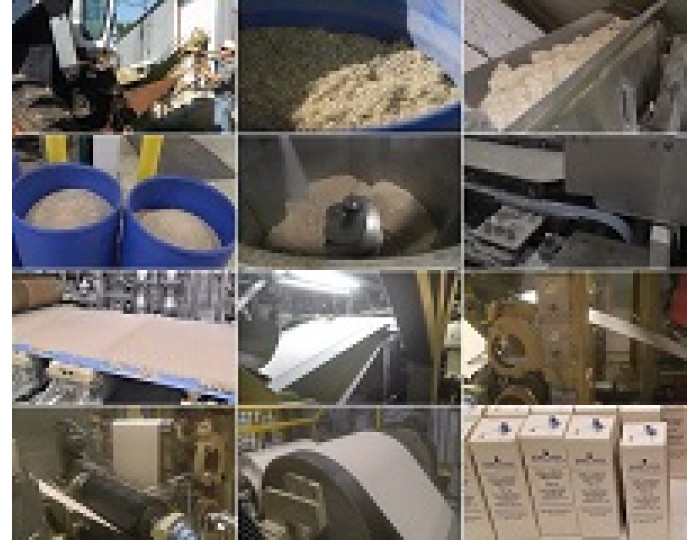
American technology for the production of hemp paper (photo)
An analysis of the use of the fibrous part of the plant in economically developed countries of the world suggests that the upward trend in the use of hemp fiber is demonstrated primarily in the segment of the creation of insulating, biocomposite materials, technical fabrics, and cellulose. The development of any of the above areas has both advantages and disadvantages, however, I would like to draw your attention to the ultra-modern technology for making paper from hemp cellulose, which is currently being introduced to the US market.
Over the past six months, the editors of the specialized electronic editions of Ukrainian hemp growers have raised the issue of the need to solve the problem facing national enterprises specializing in the processing of hemp fiber due to the fact that the demand for this raw material in our country is still small, and on foreign markets you can go out only in cases where there is an opportunity to dump by price, while maintaining a quality comparable to our colleagues engaged in similar activities at least in the EU. In order to obtain information on possible ways out of the current situation, the editors asked the specialists of the information and analytical platform “Hemp Consulting” to explain how it is expedient to operate on the national market for enterprises related to the processing of hemp fiber. Taking into account the agreements reached with the analysts of “Hemp Consulting”, we publish the opinion provided by the information and analytical platform without any changes or cuts.
There is an ironclad rule “the market dances from the consumer”. It is necessary from the outset to understand that the current situation on the national market for hemp fiber is absolutely inconsistent with what is happening in the economically developed countries of the world. On the one hand, in Ukraine at the moment, the main sphere of using the fibrous part of the plant is the manufacture of textile or knitted goods, nonwovens, footwear or accessories. Unfortunately, the nature of the market cannot be fooled, therefore, products made from high-quality natural fibers will always cost more than similar samples made from synthetic threads or viscose. Considering the frankly poor population of our country, it is not necessary to say that this segment of the market for the fibrous part of the hemp plant will become a driver of development in the next few years.
On the other hand, the analysis of the use of the fibrous part of the plant in economically developed countries of the world suggests that the upward trend in the use of hemp fiber is demonstrated primarily in the segment of the creation of insulating, biocomposite materials, technical fabrics, and cellulose. The development of any of the above areas has both its advantages and disadvantages, however, I would like to draw your attention to the ultra-modern technology for making paper from hemp cellulose, which is currently being introduced to the US market.


Hemp paper production chain entering the American market
This segment of the national hemp market is extremely promising for several key reasons at once:
- national processing industries operate exclusively on imported cellulose, so the Ukrainian market is extremely promising in terms of filling it with high-quality and cheap local raw materials;
- the concept adopted in the EU for the gradual withdrawal from circulation of derivatives from fossil raw materials (polyethylene, plastic, etc.) opens up an almost unlimited market for economically developed European countries that are ready to use hemp cellulose for the manufacture of bags, disposable tableware, etc. .;
- all over the world, the production of hemp pulp belongs to the sphere of the “green economy” and, among other things, indicates that the technologies used in the course of these productions are characterized by a negative level of carbon emissions;
- industrial hemp can produce four times more paper per unit of planting area than trees, and it takes about four months for the hemp stems to ripen, while the trees take at least 20 years;
- the stem of industrial hemp contains much more cellulose than wood. Hemp paper is more environmentally friendly - from clearcutting, loss of biodiversity to toxins released during traditional wood-based papermaking. Hemp pulp does not require bleaching or as many chemicals as wood pulp;
- hemp paper is resistant to degradation, does not turn yellow or brown with age. It can be recycled up to eight times, compared to paper made from wood, which can only be reused three times.
Commentary of the specialists of the Association "Ukrainian technical hemp"
Of the world's five largest paper producers, four are in the United States. Most likely, the created American technology for the production of paper from hemp cellulose is unlikely to ignore the technologists of the above companies from International Paper, Georgia-Pacific, Weyerhaeuser or Kimberly-Clark, who are actively exploring the possibilities of replacing traditional raw materials with hemp pulp.