

Analysis of the potential of the therapeutic hemp market (part 2)
In China, hemp is again used in the textile industry , with the goal of reducing cotton production and possibly even replacing it in the future almost completely. There are large programs in the north-east of China to introduce enzymatically processed hemp fibers into the textile industry . The Chinese auto industry also uses hemp fiber for lightweight construction. The total area of cultivated land increased from 40,000 ha (2016) to 47,000 ha (2017).
After hemp almost completely disappeared after the Second World War and with the worldwide ban on cannabis as a plant that is cultivated, as of today in Canada , China and the European Union, the plant is grown on an area of about 150,000 ha.
Regulatory support in the field of "medical" hemp breeding
At the conference of the European Industrial Hemp Association (EIHA), a map of the EU countries was presented where the use of the low-drug (therapeutic) cannabisa is allowed. Now 21 out of the 28 countries that are part of the EU have adopted legal acts regulating the legality of the use of hemp or medicines made on the basis of the plant.

EU countries where cannabis is used for medical purposes
Normative legal acts regulating the legality of the use of hemp for medical purposes have been adopted by the following EU states :

However, it is worth noting that in countries where the use of hemp for medical purposes is not currently regulated, work is underway to create a regulatory framework that will allow the therapeutic properties of the plant to be used .
The most rapidly growing hemp market is in China . China is the largest exporter of hemp paper and textile . Most clothing brands are made in factories in China . Although it’s hard to say how big the cannabis industry actually is in China , a recent analysis showed that it is around $ 200 million.
Cannabidiol (CBD) is approved as a medicine in almost all European countries and is grown in greenhouses for the needs of the pharmaceutical industry. Last year's International Conference in Harbin ( China ) was one of the largest events that have ever been held. 300 delegates from China , Australia , Europe and Canada presented success stories from around the world and discussed future production and marketing strategies for even better hemp products . The conference demonstrated the importance and versatility of ecological products from plants .
The cultivation area in Heilongjiang Province of China alone increased to 74,000 acres (30,000 ha) last year alone - an area comparable to the total hemp cultivation area in Canada or Europe . And the plans of provincial officials to double the area of cultivation of the plant next year.
Over 500 patents have been granted in the hemp industry in China . They include sowing , processing , textiles , food , oil , paper manufacturing, medicine , etc. Most of them are owned by Chinese companies and private entrepreneurs, and some by foreign enterprises.
In recent years , research , sowing and processing of hemp has been rapidly developing in China . The industrial hemp sowing area in China in 2017 was about 50 thousand hectares. There are more than 20 companies producing CBD.
Universities from Heilongjiang, Ukraine and Canada have launched a comprehensive research program to develop new hemp varieties , more versatile and efficient harvesters and new technologies for the production of hemp fibers, seeds and inflorescences . Berlin-based HANF FARM GmbH has developed the unique Multicombine HC 3400 combine.
The leadership of Heilongjiang Province is convinced that it is on the right track and is looking for partners in Europe and North America for international cooperation. They have the resources to create a modern industry and provide subsidies, as well as effective infrastructure.
And what about hemp crops in Ukraine ? Analyzing the dynamics of changes in hemp sowing areas in Ukraine over the period since 2000, it can be noted that growth from 0.3 thousand ha in the worst year (2009) to a relative peak (3.47 thousand ha) in the last period was the result of painstaking the work of the Bast Institute and the Ukrainian Technical Hemp Association in the direction of popularizing culture and changes in the regulatory framework.
The decline in sown areas (2.7 thousand ha - 2017, 1.3 thousand ha - 2018) is primarily due to the unstable demand for hemp products (raw materials - fiber , seeds ; finished products - processed food , textile and construction products) products, energy products ). The development of the hemp breeding processing industry will positively affect the development of the industry , which will make it possible to obtain not only raw materials for sale, but also a finished product at affordable prices. The medical use of hemp for Ukraine can become not only an incentive for the development of the hemp industry, but also for the development of related processing sectors of production.

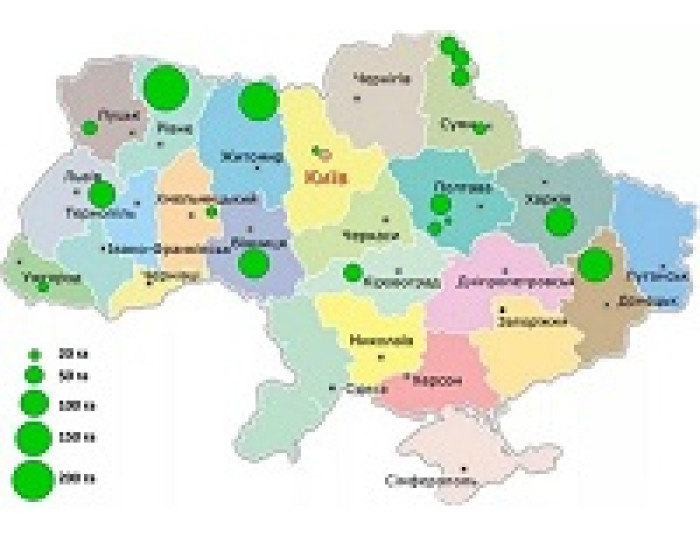
Location geography of hemp enterprises in Ukraine in 2018
Interesting industry development experience in Uruguay
Uruguay is a country that seeks to regulate the medical cannabis market . The main part of this market in the state was until recently in the shade. According to a published report by the relevant government agencies, despite problems with the supply of legal hemp, Uruguay redirected the sale of cannabisa by about $ 22 million from the illegal sector to a regulated market . In accordance with the policy of the aforementioned South American country, the implementation of the hemp policy of the state was rather slow. From the moment of its adoption in 2013 to the present day, adult citizens of the country have three legal options for using cannabis:
- growing plants in home / private conditions - the mechanism has been working since 2014;
- the use of hemp in social hemp clubs - since 2015;
- sales of products through the pharmacy system - from July 19, 2017.
According to experts from the hemp market, 68% of registered users legally grow a plant in the private sector, 20% are members of hemp clubs, and only 12% of total sales come from pharmacies.
According to a joint official statement issued by the Cannabis Regulatory and Control Institute (IRCCA) and the Uruguayan cannabisa regulatory agency, the current situation is hampering the development of the system and its beneficial effects, such as reduced illegal access to marijuana and the gradual increase in the use of controlled products with hemp regarding their quality and safety, as well as changes in the practice of consumption of products .
Constant problems with the supply of the required amount of legal hemp prevented until recently the normal functioning of this business. The regular acute shortage of the product required by the market led to the start of a new application process in early February to increase the number of manufacturing companies
As part of this process, it was decided to select an additional three companies that will be engaged in the cultivation of hemp. Each of the winning companies must sign a contract with the government for the annual supply of 2000 kg of “green mass” of the plant, and they plan to conclude contracts for 5 years. It is planned to move companies that have lost the competitive selection to an additional “waiting list”, which government structures can bring to the market if a decision is made to further expand this market in the country.
Currently, only two companies have been granted licenses for the legal cultivation and sale of recreational hemp in pharmacies authorized to carry out this activity. The only retail outlets where cannabis can be legally purchased in Uruguay is the ICC Labs pharmacy chain, which was recently acquired by Canadian company Aurora Cannabis and Symbiosis. In the first 500 days of legal sales of psychoactive hemp using the above pharmacy network, a total of 1916 kg was sold (an average of 3.8 kg / day). The total sales in pharmacies amounted to about $ 2.6 million, of which manufacturing companies earned $ 1.8 million.

Cannabis sales in pharmacies in Uruguay
The main conclusion that suggests itself from the experience of Uruguay is that the state should not turn its back on hemp market regulation . An appropriate program should be developed that can regulate in any legal field any hemp market in the country - recreational, medical, therapeutic, industrial . Failure to acknowledge the existence of problems in the field gives rise to the black market and corruption, which is inappropriate in the first place to attract investment .
The nuances of the Ukrainian market of "medical" hemp
Some initiators of the appeal to the Supreme Council on the legalization of medical marijuana categorically argue that in our country about 2 million patients are potentially interested in cannabis preparations. This figure is clearly overstated. In order to confirm or refute these claims, the Ukrainian Technical Hemp Association ordered an analytical study of the medical hemp market in the countries of the European continent from the Hemp Consulting consulting company . Research data showed that, for example, in Israel (8.9 million people, the country constantly wages war), where medical hemp and drugs based on the therapeutic properties of the plant have been actively used for more than 20 years , only about 25 - 30 thousand patients use cannabinoid therapy . In the EU countries and in Canada, the number of patients using the therapeutic properties of hemp or drugs based on them is comparable with the Israeli figures, but not with the 2 million citizens indicated in the petition. According to the calculations of studies conducted by Hemp Consulting in Ukraine, about 200 thousand potential patients are interested in the need for cannabis preparations or hemp therapy . The development of the domestic regulatory framework and the development of Ukrainian capacities for the production of a closed chain - cultivation - primary processing - the production of therapeutic or pharmaceutical preparations, will expand the circle of potential patients to 500 thousand. It should be noted that the development of the regulatory framework should occur simultaneously with the planned information state policy aimed at creating a positive image of hemp therapy , respectively, is confirmed by clinical and scientific my research. Therefore, it is necessary to develop related high-tech industries - breeding , agricultural technology, the processing industry , etc.
Why are foreign companies interested in developing the medical field of hemp use ? Very often, foreign medical preparations are made either on the basis of synthetic cannabinoids (harmful to health) or on the basis of extracts of specifically taken cannabinoids (in the vast majority - cannabidiol, in much smaller quantities canabinol, canabichromene, cannabigerol, etc.). However, during the extraction, up to 90% of the medicinal properties of the plant are lost and, most importantly, the bonds are broken, on the basis of which the cannabinoids "work in the ensemble" - reinforce each other's work. In addition, in some cases, scientists still do not know which cannabinoids have a therapeutic effect in relation to a particular disease. There is another nuance that is not voiced by manufacturers of cannabis-based drugs. In the event that the drug contains more than 0.8% THC, the drug practically does not work (its therapeutic properties are lost). Nature created the plant in such a way that the effect of THC in hemp is balanced by the counteraction of other cannabinoids, primarily CBD. These properties correspond to varieties of technical hemp of a therapeutic orientation , which are bred on the territory of our country. Therefore, foreign manufacturers of medical cannabis are interested in discovering our market right now, when the domestic industry is weak and underdeveloped. This will give them the opportunity to control the market and establish their own “rules of the game." And with our corrupt officials of all ranks - this is not difficult.
For our consumers of hemp products and potential patients requiring hemp therapy, there is also one interesting observation from scientists and market experts . Why should a person take medicine if it is enough for a patient to eat therapeutic therapeutic hemp leaves and inflorescences ? Today there are hemp varieties bred in Ukraine, in which THC is less than 0.05%, and CBD is more than 1.5% . The experiments show that the use of fresh or dried therapeutic hemp leaves of a therapeutic nature gives a huge therapeutic effect - it significantly reduces pain and cures migraines, allergies, various neurodegenerative diseases, etc. In Ukraine , having issued the appropriate permits, you can grow the above grade Curative / treated or buy juice, smoothie, seasoning, food , cosmetics , Additives supplements , etc.., which already exist and are in great demand on the domestic market . At the same time, the Ukrainian consumer will buy goods for tens of hryvnias, and not for hundreds of dollars, pharmacological preparations based on hemp extracts made abroad.
conclusions
First , the issue of amending the legislative framework in accordance with which the therapeutic properties of hemp will be used not only for industrial, but also for scientific and medical purposes, must be treated positively. But there is no need to change the legislative framework in the interests of foreign companies that are lobbying for the opening of a market for products of dubious quality. In Ukraine, created new technical varieties of cannabis therapy , the use of which gives the best result at more affordable prices than pharmaceuticals, imported from abroad.
The second - if we talk about the national practice of treatment with leaves and inflorescences of technical hemp of a therapeutic orientation , then it is extremely effective . No need to buy very expensive foreign drugs based on hemp extract. You can buy oils , juices, seasonings, cosmetics, or by issuing the appropriate permits to independently grow non-narcotic varieties of a therapeutic orientation and on an ongoing basis to heal or be treated . In addition, Ukraine has experience when appropriate conductors and catalysts are added to the "green mass" of plants and the resulting substance, which excludes extraction (currently prohibited by law), is extremely effective in the treatment of very serious diseases, including chronic ones . There are documented examples in Ukraine of the treatment of inoperable forms of cancer , in particular of persons with the fourth (terminal) stage of cancer.
Third , how to accelerate the legalization of hemp in Ukraine ? You can follow the path that the Ukrainian Technical Hemp Association has been using for a long time . To amend the legislation through the decisions of the CMU. This is a much simpler and more efficient way to use for industrial purposes hemp leaves and inflorescences , in the dried straw of which the THC content does not exceed 0.08%. Experience shows that PKMU undergoes review and is accepted within 4-5 months. In fact, in the case of the adoption of such changes in 2020, patients in Ukraine will be able to be treated with the green mass of technical hemp of a therapeutic nature , and from April 2020 , anyone who wants to can grow non-narcotic varieties that have a significant therapeutic effect if if they complete the necessary permits in such cases .
PS Today it is quite difficult to assess the potential market for therapeutic or medical hemp in Ukraine , since its use is not permitted by law. An analysis of similar markets for medical hemp developing in Europe shows that the potential number of patients who can use cannabis-based medicines is predicted by experts for the next 5 years in the amount of 1 - 2% of the total population. For our country, this is about 500,000 patients. But it should be noted that this figure is possible only if the use of appropriate drugs is legally legalized. In the opposite case, even this number of patients in Ukraine will not be. And one more factor should be taken into account, the psychological readiness of people to use the “new” method for treating medical hemp for them . Not every patient who needs such treatment will be ready to apply it for himself, because in our conservative society, stereotypes regarding hemp plants are still strong.