

The dynamics of the development of the market for beverages infused with hemp in the United States
The appearance on the market of hemp drinks of a number of large brands specializing in the production and sale of non-alcoholic water or low-alcohol / alcoholic products suggests that this market is preparing for an exponential jump in the growth of consumption of this particular category of goods, at least in North America.
On the pages of the specialized electronic edition of Ukrainian cannabis growers, attention was previously focused on the fact that “ About a third of the solvent population of economically developed countries of the world are ready to use drinks, which include therapeutic elements of hemp ”. With a certain frequency, global brands announce the introduction to the market of various samples of non-alcoholic, low-alcohol, alcoholic products, the recipe of which assumes the presence of various components of the hemp plant (grain, root, leaves and inflorescences, young shoots) or their derivatives (seed extracts, root tinctures, extracts from flowers including cannabinoids, terpenes, flavonoids, etc.).
The emergence in the United States of the large American brewing brand Pabst Brewing Company, which, together with Pabst Labs (a Californian hemp company) and Space Station (a co-packer and contract manufacturer), introduces non-alcoholic sparkling water with lemon in which will contain cannabinoids demonstrates certain trends that have been observed for the third year in a row in the market for food and beverages made on the basis of the therapeutic properties of the hemp plant.
Experts in the American market say that at the moment, hemp-infused drinks make up only a small part of the market (about 10%) of products that contain various hemp components. For example, in September 2020, sales of infused hemp drinks in California were about $ 3.4 million - already comparable to the sales of $ 40 million received over the same period of time by the market for edible products that include various constituents of the hemp plant. ... However, market experts point out that sales of infused drinks in California almost doubled in September compared to the figures that were recorded a year earlier, while sales of food products grew by “only” 53%. It is noted that the total market for hemp-infused drinks in California, Colorado, Nevada, Oregon and Washington alone in August 2020 was $ 7.9 million. Comparing with $ 2.3 million of sales recorded in the same administrative-territorial units of the United States in August 2017, it can be stated that in this sector of modern cannabis growing in the most highly developed country in the world, there is a rapid increase in the dynamics of production and, accordingly, sales.

Growth dynamics of sales of hemp-infused beverages in selected states of the USA (California, Colorado, Nevada, Oregon and Washington)

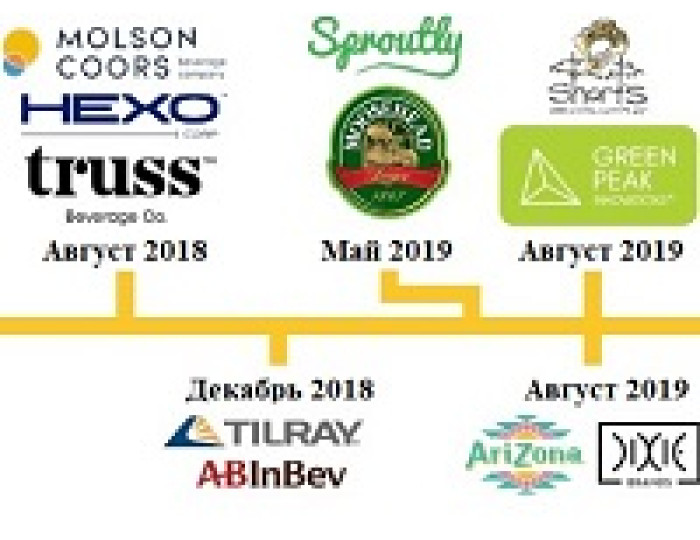
The history of bringing hemp-infused beverages to the market by various brands in North America
In August 2017, Lagunitas Brewing Co (owned by Dutch brewery Heineken) partnered with Californian hemp concentrate company AbsoluteXtracts, which subsequently launched Hi-Fi Hops, a non-alcoholic beverage with cannabinoids.
In October 2017, Constellation Brands (known for beers such as Corona, Modelo and Ballast Point) acquired a 9.9% stake in Canadian brewer Canopy Growth. The company increased this investment in 2018 and now owns 38.6% of Canopy.
In August 2018, Molson Coors and Hexo Corp. created Truss Beverages to produce hemp-infused beverages for the Canadian market.
In December 2018, Anheuser Busch InBev (the largest brewer in the world) and Canadian cannabis producer Tilray formed a joint venture to produce soft drinks based on various plant derivatives.
In May 2019, Sproutly Canada, Inc partnered with Moosehead Breweries to launch multiple hemp-based drinks.
Commentary of experts of the Association "Ukrainian technical hemp"
The appearance on the market of hemp drinks of a number of large brands specializing in the production and sale of non-alcoholic water or low-alcohol / alcoholic products suggests that this market is preparing for an exponential growth in consumption of this particular category of goods, at least in North America.
The need to adopt departmental regulatory legal acts regulating the possibility of using the leaves and inflorescences of therapeutic hemp for industrial purposes, including for the creation of national drinks, which will include non-drug cannabinoids of plant origin, will be raised during the round table “Experience of using therapeutic elements of industrial hemp as raw materials for food, cosmetics, biologically active or feed additives ”. This event will be held on October 14, during the second day of training for 5th year students of the "Hemp University".