

The House of the Future with Hemp Technology Awarded Solar Decathlon Award
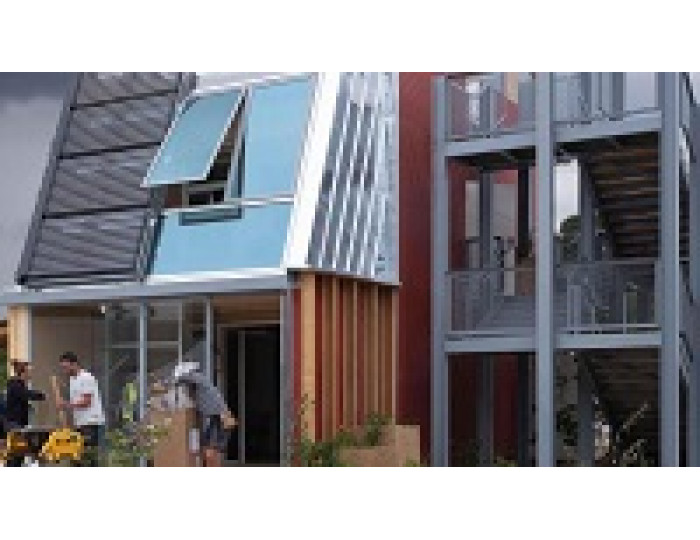
We worked on the energy-saving efficiency of the building with the help of ecological cotton and hemp insulation, thought about insulation curtains, as well as dozens of modern technologies that allow houses from the last century to meet modern environmental / economic / energy-saving requirements. By scaling up our achievements on this project, it is possible to significantly reduce the energy consumption of structures built in the last century and make most of them such that earn on the production of electric energy, rather than consume it.
A team of students from the French region of Hautes-de-France won the European Solar Decathlon competition held in Hungary, at which participants presented prototypes of the “carbon-free” environment of future generations. Their project of reconstruction of houses in the style of "1930" was extremely liked by the panel of judges.
The construction of houses under the code name "1930" in themselves is a "sieve" in terms of energy conservation. There are about a million such houses in the north of France alone. It was by realizing this problem that a group of students from the Hautes-de-France region found a solution to how to adapt brick-built houses massively built in the industrial era to modern energy efficiency readings. two years over
The Habiter2030 project, supported by the Lille School of Architecture and a community-based organization providing young people aged 15 and over with the opportunity to learn traditional occupations, Les Compagnons du Devoir, introduced the 1930s home insulation concept at Solar Decathlon Europe (SDE) 2019. For 2 years, students Architects, engineers, designers and young scientists built an exact copy of the townhouse of the 30s of the last century with one goal - to optimize this model of the house for the energy costs required for modern buildings and structures niyam.
According to project coordinator Lucy D'Hont, “We worked on the energy-saving efficiency of the building using ecological heaters made of cotton and hemp, thought about insulation curtains, as well as dozens of modern technologies that allow houses from the last century to meet modern environmental / economic / energy-saving requirements. By scaling up our achievements on this project, it is possible to significantly reduce the energy consumption of structures built in the last century and make most of them such that earn on the production of electric energy, rather than consume it. Winning the SDE 2019 competition will help implement environmental projects as part of the “third industrial revolution” for both the whole of France and the Haute-de-France region. Therefore, the next step in these works will be the repair of a real house built in 1930, at which the owners of such buildings will be clearly demonstrated that the improvement of their facilities is absolutely financially affordable and pays off in a very short time. ”
Commentary of the Ukrainian Technical Hemp Association
A team of students from the French region of O de France called Habiter 2030 brought together representatives of 14 schools (teachers, students, instructors, construction specialists) to participate in the Solar Decathlon Europe 2019 competition. The task of Habiter 2030 was to build a building in Villeneuve d'Ask , which later participated in the SDE 2019 competition. After the construction of the building, a group of like-minded people was entrusted with the task of transporting this building from Villeneuve d'Asc to Lille, with its subsequent sending to the competition in Hungary. After the end of the competition, the building was dismantled again and returned back to France.


Solemn procedure for the beginning of the assembly of the building of the project "1930"
One of the requirements of the international Solar Decathlon competition is for the teams to present a structure in which the generated energy will be 100% solar. Solar Decathlon is an international architectural and engineering competition funded by the United States Department of Energy (USA) and the National Renewable Energy Laboratory (USA). Projects are evaluated in the categories: architecture; comfort, interior; project documentation; communications; climatic comfort; Appliances; hot water; lighting; overall energy balance; mobility (estimated maximum mileage of an electric car on the energy provided by the equipment at home).
Within the framework of the “ Hemp University ”, the specialized association of Ukrainian hemp breeders regularly holds various forms of classes (seminars, conferences, round tables, master classes, etc.). This fall, it is planned to hold a round table on a rather relevant topic: "Hemp raw materials: technologies for its use in construction, production of biocomposite materials and furniture . "