

Canadian hemp in South Korea
Demand for hemp seed in Asian countries is so great that even in the case of a country other than the harvest in 2016 will not be able to fully satisfy it.
By the cultivation of industrial hemp cultivation technology for quite a long time are showing increased interest in Canadian farmers. By promoting their products on the international market, excellent results Canadians received in the Asia-Pacific region, particularly in South Korea.
The impetus for the active dissemination of foods from hemp seeds has become a culinary show, organized at one of the central TV channels in South Korea last winter. Canadian chefs, nutritionists and experts clearly explained to participants and viewers that hemp protein for the human body is the most digestible and also contains in itself incomparably greater amount needed for the human body of nutrients than any other food product supply vegetable or animal origin.
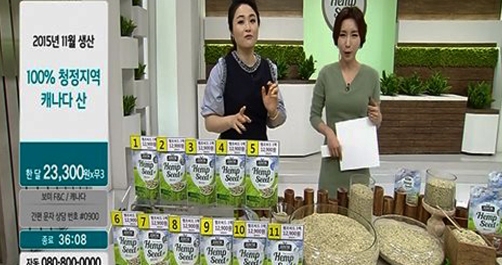
South Korean consumer enthusiasm was such that within 30 minutes after the end of the cooking show more than 9000 kg of hemp seeds were sold. Yet for weeks, Canadian traders have concluded hundreds of agreements for delivery of food hemp seeds and its derivatives on the shelves of dozens of grocery chains and individual stores in South Korea. Throughout 2016 the nutritional properties of hemp grain is so liked by South Korean consumers that for the season in 2017 the volume of sale of hemp seeds and products made from it is planned to increase by several times.
Hemp instead of fish and meat
On the Asian market, technical hemp seeds are considered to be an excellent alternative to fish in large numbers present in the South Korean cuisine dishes. In addition, one of the leaders of a Canadian company specializing in the promotion of hemp products in South Korea claims that the food market in Asia reacted positively to the vegetable protein from hemp and slightly replace animal protein is hemp protein. According to the product to market analysts, there is a gradual increase in demand in the Asia-Pacific region on various food products made from hemp seeds. Especially actively developing mutually beneficial cooperation in this field is between Canada and South Korea.
Canadians have to produce more to meet growing demand
According to the Canadian cannabis traders, the demand for hemp seed in Asian countries is so great that even in the case of a country other than the harvest in 2016 will not be able to fully satisfy it. Therefore, market analysts predict a gradual increase in prices for raw materials and hemp produced from it the final product at the end of 2016, beginning of 2017. In order to somehow meet the growing demand for hemp protein from consumers in Asia, Canadians would have to double the amount of production of hemp seed imported into the region for the past 2017-2018 years. Represents an opportunity to not go unheeded hemp structures in Canada, so more and more farmers are involved in the country's growing industrial hemp cultivation technology.
According to one of the Canadian producers Brent Kennedy hemp grain (Brent Kennedy), he began to grow hemp malonarkoticheskoy in 2015, as the plant fits perfectly into the framework of the developed land for its rotation. Last year, he as an experiment cultivated 73 hectares of industrial hemp. In the same year, he took a chance to grow the plant in general is already on 201 hectare. The next year he plans to triple the area of industrial hemp crop and bring the area under cannabis cultivated land of 600 hectares. According to Mr. Kennedy, it is the demand of the Asian market for its hemp justifies a significant increase in the acreage under crop in Canada. In addition, while it only works with the grain, not really paying attention to the least profitable part of the plant. However, already received in the industrial konoplevodstve income allows him to think about, to process the leaves and blossoms for the needs of the cosmetic or pharmacological markets. In the future, agreeing with manufacturers of thread, a farmer is planning to consider the installation of equipment for primary processing of trests and fibers and the kostra that he can sell as highly effective raw materials for the textile and clothing industry, pet industry, the construction industry or as bio fuels.
Information taken from the site http://tku.org.ua