

Cannabis growing in Latin America is considered a locomotive in the development of the agricultural industry
Three main factors stimulating the consolidation of assets of individual companies to create closed production chains in the region: favorable climatic conditions and experience in the cultivation of industrial crops of industrial hemp; dynamically developing regulatory framework; a rapidly growing regional market for hemp products, as well as opportunities for its use by consumers.
After significant advances in the development of modern cannabis growing in Uruguay and Colombia, the Latin American cannabis industry is growing at a rapid pace, crystallizing individual areas in which each of the countries in the region specializes. First of all, government agencies that are actively involved in the creation of relevant regulatory legal acts within their countries are betting on the fact that the region's countries are characterized by low production costs for cultivation and processing in comparison with states located in North America or Europe, as well as ample opportunities assuming the presence of a skilled labor force, a developed infrastructure, a history of growing and processing the most profitable agricultural crops and the possibilities of exporting them to the markets of economically developed countries of the world.

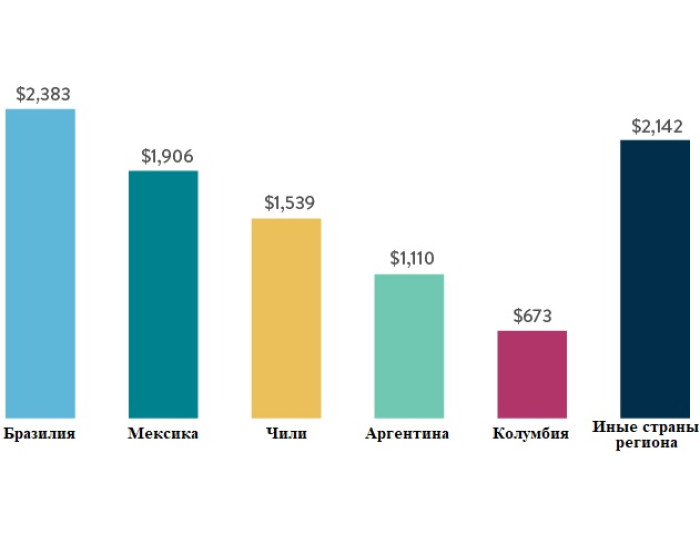
Size of major Latin American markets
At the moment, analysts of the global hemp market note three main factors stimulating the consolidation of assets of individual companies to create closed production chains in the region:
- favorable climatic conditions and experience in the cultivation of industrial crops of industrial hemp
Large Latin American companies are well aware that selling agricultural products in international markets is an extremely difficult business. Without economies of scale, international competition is extremely difficult. Consequently, many companies have focused on developing products with high added value and creating their own supply chains for the final product to the consumer.
- a dynamically developing regulatory framework
The foreign investment already attracted by Uruguay and Colombia following the adoption of the relevant regulatory framework has prompted the governments of other countries in the region to reconsider their position on the possibilities of using hemp. Ecuador, Mexico and Peru are currently developing strategies for the development of the local cannabis industry, and the Panama government is discussing how to amend the current regulatory framework in order to “kick-start” entire sectors of modern cannabis production.
- a rapidly growing regional market for hemp products, as well as opportunities for their use by consumers
The region's hemp companies are realizing the huge potential of the regional market. With a population of 600 million people, the Latin American market for modern cannabis breeding can reach $ 10 billion in the near future. For example, the Latin American market offers tremendous opportunities for work in this sector of cosmetic companies due to the presence of a large number of high-quality laboratories, equipment, the possibility of using high-quality ingredients. low production costs and specialist experience. Likewise, the countries of the Andean Community of Nations have a common regulatory framework that allows cosmetic products to be commercialized in several states in the region at once.