

Hemp rebar to be used in US green building

We pay special attention to the number of
projects implemented in the United States over the past few years to introduce
hemp raw materials into various kinds of technological chains. In particular,
implementing the strategy of US President Joseph Biden to reduce the negative
impact on the environment, the country is actively developing know-how that
contributes to the decarbonization of various sectors of the economy of the
most highly developed country in the world. The example of the introduction of
“hemp rebar” into the construction industry demonstrates the commitment of
officials to the introduction of hemp technologies, as well as environmentally
friendly natural raw materials, into the construction industry, at least in New
York.
Hemp
fibers are the longest and strongest molecular chain created by nature . Despite the fact that this
feature is well known to the global hemp industry, the above-mentioned
properties of hemp fiber in the field of “green building” are being
commercialized by specialists from the Rensselaer Polytechnic Institute (RPI).
RPI researchers at an ongoing seminar with New York State
government officials presented their technology for using "hemp
rebar", which would be useful to enhance the strength as well as the
reliability of traditional cement structures. In particular, Alexandros Tsamis,
associate professor of architecture and deputy director of the Center for
Architectural Sciences and Ecology, and Dan Valchik, professor of mechanical
engineering and director of the Center for Industrial Innovations, presented
hemp-based thermoplastic rebar reinforced with natural fibers. According to the
above experts, the “hemp rebar” they developed can replace steel in concrete
structures or various infrastructure projects, eliminating common corrosion
problems and extending the life of various building structures.
According to the developers, “hemp rebar” can be used to
create skeletal frames in conventional cement buildings in order to provide increased
tensile / compressive strength that traditional concrete structures lack.
During the presentation, the research team said that a
preliminary study of the natural building material they invented showed
strength characteristics comparable to steel and the potential to significantly
reduce greenhouse gas emissions.
During the seminar, the specialists of the Rensselaer
Polytechnic Institute focused on the fact that their efforts are aimed at the
development and implementation of several innovative and cost-effective
processing technologies, as well as the use of hemp. These projects include the
development of a state-of-the-art decortication technology that can separate
hemp fibers from hemp without adversely affecting the mechanical properties of
the resulting raw material; sustainable refining method; as well as new methods
for the production of hemp biocomposites.
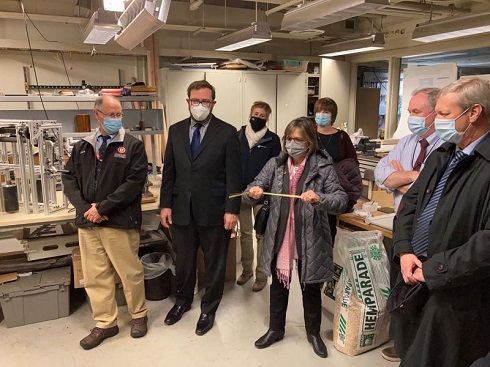
From left to right, Chuck Schmitt, Horticultural
Specialist, New York State Department of Agriculture and Markets; Stephen
Fleming, Director of Industrial Development, Empire State Development; Rene
Saint-Jacques, Assoc. Director of Public Policy, New York Farm Bureau; MP Donna
Lupardo, Member of the Assembly; Amy Abbati, legislative director of the
Assembly's office; Tim Sweeney, Technical Hemp Coordinator, New York State
Department of Agriculture and Markets; Randy Volken, President and CEO,
Manufacturers Association (MACNY)
Commentary of the specialists of the
Association “Ukrainian Industrial Hemp”
We pay special attention to the number of projects
implemented in the United States over the past few years to introduce hemp raw
materials into various kinds of technological chains. In particular,
implementing the strategy of US President Joseph Biden to reduce the negative
impact on the environment, the country is actively developing know-how that
contributes to the decarbonization of various sectors of the economy of the
most highly developed country in the world. An example of the introduction of
“hemp reinforcement” into the construction industry in the described material
demonstrates the commitment of officials to the introduction of hemp
technologies, as well as environmentally friendly natural raw materials, into
the construction industry, at least in New York.