

A brief analysis of the therapeutic cannabis market
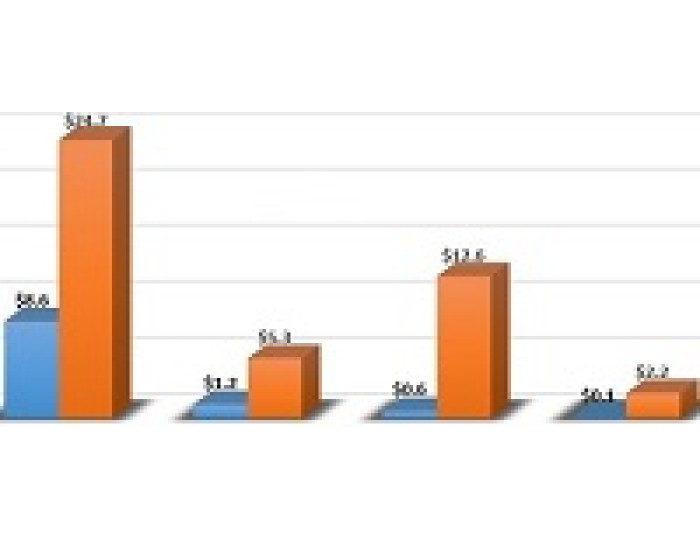
Perhaps the biggest surprise is how quickly retailers can become large cannabinoid companies for products that do not have a THC. It is expected that after revenue in 2018 was only $ 0.6 billion, by 2024, American retailers will be able to earn $ 12.6 billion on non-THC products.
At the moment, analysts of the American stock market do not see other branches of economic activity that imply a greater potential for long-term growth than industries associated with modern markets for cannabisation. Medium-term forecasts for the global hemp market may reach $ 166 billion. At the same time, Bank of America analyst Christopher Carey fears that the rapidly growing market of American / global hemp production may turn out to be another financial "bubble" that disperses the value of shares of companies that do not really can achieve the declared results of activity. On the other hand, since tens of billions of dollars are spent on the illicit market, and modern hemp production can “move” these resources for their legal use in the medical or recreational sphere, the boldest forecasts by American analysts can be realized in the next 5-10 years.
The analysts of the US stock market prepared a report entitled “The State of Legal Hemp Markets”, in which an attempt was made to predict the trends of modern cannabisation, which exploits the possibilities of legally using the therapeutic properties of the plant. Taking into account the fact that materials in this area of business have been systematized since 2014, a 10-year analysis of the development of the above highly liquid global market has been prepared.
Sales of hemp in the period from 2014 to 2018, as well as analysts' estimates for the prospect of 2019-2024, allow the data to be tabulated.


Analysis of the data systematized in the table shows that over the decade the average annual market growth rate was 28.2%, including for the six-year period (from the end of 2018 to the end of 2024) it was 24.5%. Those. The average annual growth rate of the industry over the decade is 28.2%.
Revenues from sales of legal recreational cannabis from $ 6.1 billion in 2018 will increase to $ 26.7 billion in 2024. In turn, sales of medical cannabis will increase from $ 4.8 billion in 2018 to $ 13.9 billion in 2024. As can be seen from the forecast, over the course of 6 years, the growth in sales of recreational cannabis significantly exceeds that of medical cannabis. This is explained by the fact that patients in those countries where recreational use of cannabis will be legal will avoid costly visits to the doctor and legally purchase cheaper recreational cannabis for treatment.
Most of the $ 40.6 billion must be received in North America (in Canada, the market will be about $ 4.8 billion, and in the United States about $ 30 billion). Costs in Europe, Latin America, Asia-Pacific and the rest of the world will increase from $ 517 million in 2018 to about $ 5.8 billion in 2024.
Despite the fact that the above figures are impressive and indicate a significant growth potential of the legal industry using the therapeutic properties of cannabis, this data does not reveal what is considered the most important - a breakdown of $ 44.8 billion of the planned costs for the purchase of cannabinoids in 2024. This value exceeds the above global cost of sales because it also includes total retail sales + sales of cannabinoids in the form of pharmaceuticals.


The graph shows how radically the legal therapeutic cannabis industry in the United States will change in the period between 2018 and 2024.
Immediately, we note that sales of products containing tetrahydrocannabinol (TGC) in licensed US pharmacies will almost triple from $ 8.6 billion in 2018 to $ 24.7 billion in 2024. Despite the fact that cannabidiol is currently best known for its therapeutic properties, it is important to understand that approximately 55% of sales in 2024 will continue to suggest the presence of THC in the product. However, this does not mean that the above $ 24.7 billion will be earned as a result of the sale of dried leaves and inflorescences of hemp. People using cannabis for medical purposes make it clear that they prefer to use THC with plant derivatives (oils, dietary supplements, topical products, cosmetics, sprays, couples, food or drinks), but not for smoking.
Perhaps the biggest surprise is how quickly retailers can become large cannabinoid companies for products that do not have a THC. It is expected that after revenue in 2018 was only $ 0.6 billion, by 2024, American retailers will be able to earn $ 12.6 billion on non-THC products.
Cannabinoid sales by pharmaceutical companies (pharmaceutical cannainoids) are expected to grow from $ 0.1 billion in 2018 to about $ 2.2 billion in 2024. Cannabinoid-based drug manufacturers will play a key role in the growth of this market sector.