

How promising is the production of "green hydrogen" from hemp
The next stage in the development of this project is the signing of a contract for € 18.8 million within which a production site will be created, the main activity of which will be the conversion of hemp raw materials into hydrogen.
One of the French energy companies in the EU market is actively promoting a project to produce “green hydrogen” from hemp. In particular, in the article “Why urban transport in French cities will ride on hemp”, we focused the attention of our dear readers and listeners on the signing of a contract between the energy company "Qairos Energies" and the first farmer in France, under which an agricultural producer will supply local energy company raw hemp. The next stage in the development of this project is the signing of a contract for € 18.8 million, within the framework of which a production site will be created, the main activity of which will be the conversion of hemp raw materials into hydrogen. According to the business plan developed by the company, at the end of 2022, the marketing phase of the project on the use of green hydrogen will begin both in public utilities and as fuel for various types of automotive and agricultural equipment. Considering the fact that in our country there are no ongoing projects related to the use of hemp raw materials as the basis for creating production facilities in the field of "green energy", we will try to understand the features of the technology proposed by our French colleagues.
One of the main advantages of “green energy” for countries actively developing opportunities for the use of alternative forms of energy, especially those with strong agricultural potential, is the fact that a huge amount of unused plant residues remains in the process of making products “marketable” as illiquid. It is this factor that is used by French specialists in order to use the raw materials obtained in this way as efficiently as possible, turning it into a highly liquid product that is in demand on the market. Another advantage of this technology is the fact that the plant for the production of green hydrogen from agricultural biomass adapts primarily to the local energy needs of producers, communities, farmers and people within a radius of approximately 35 kilometers. Those. its operation of production facilities allows fully providing energy to the inhabitants of the region of its installation, including refueling of automobile and agricultural equipment, without assuming any structural changes in the available equipment or machines. Among other things, this technology creates new jobs in the traditionally depressed agricultural regions of the country. That is why the specialists of the energy company "Qairos Energies" are positioning this technology on the market as revolutionary, since the production and consumption of energy takes place in one place, without implying any additional costs.
Green hydrogen production from hemp
Common sense suggests that in cases where the terrain assumes the presence of significant agricultural land, it is economically viable to obtain "green hydrogen" from agricultural biomass, and given the energy performance of industrial hemp, the most optimal solution for the operation of this technology is the use of raw materials provided in during the cultivation of this particular plant.

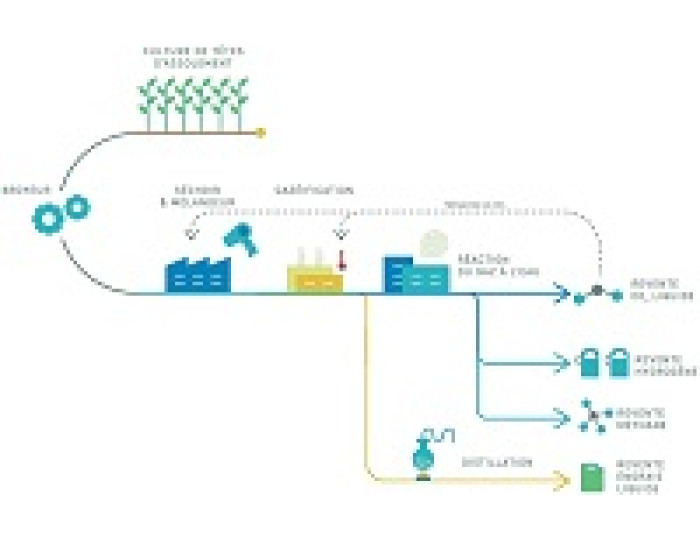
Schematic diagram of the installation of the company "Qairos Energies"
The hemp biomass collected from agricultural activities is sent to a plant for the production of “green hydrogen” and methane. To create alternative energy sources, five main production steps are performed:
- crushing of raw biomass into small particles;
- drying and mixing to obtain a homogeneous material;
- gasification - transformation of raw materials into gas under the influence of heat;
- the reaction of gas to water (methane, “green hydrogen” and carbon dioxide are collected in the liquid),
- distillation (production residues are converted into liquid fertilizer).
During this process, all biomass supplied for use is used. It is gasification that avoids unnecessary waste.
Products obtained during the production cycle
The following products are formed from the incoming biomass after processing, which are in demand in the circular economy:
• “green hydrogen” - distributed through hydrogen stations for use as fuel in cars, trucks and tractors equipped with an appropriate engine or fuel cell;
• methane - pumped into a standard gas network;
• carbon dioxide - used for cooling devices in various industries;
• liquid fertilizer - not containing hydrogen and therefore less aggressive for the soil, intended for use in agriculture in areas adjacent to production facilities.
The use of such installations is extremely effective, since the production capacity for the processing of agricultural biomass can provide the same amount of energy as about 10 thousand households consume or the equivalent in fuel for the operation of 12 700 diesel cars throughout the year. According to the authors of the project, since plants for the production of "green hydrogen" from agricultural biomass can be adapted to local needs, and they are not difficult to manufacture, they can be quickly deployed in other regions of the country to meet the needs of the transition to green energy in almost all regions of France ...