

Features of the British prefabricated hemp building “Flat House”
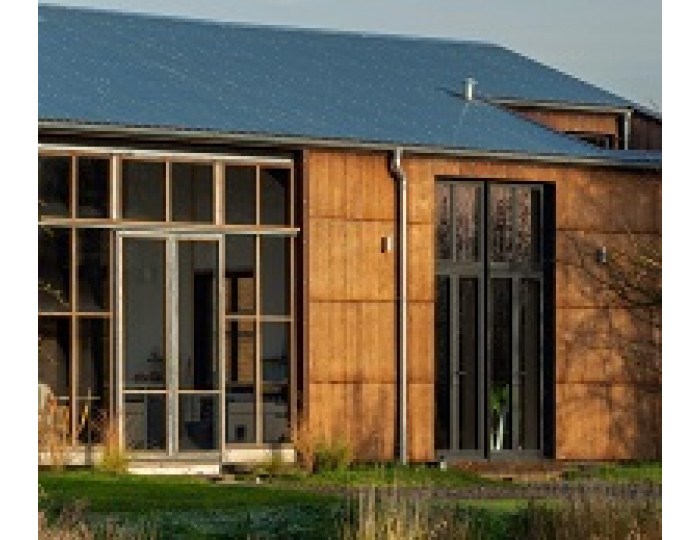
The first experimental building within the framework of the “Flat House” project is currently being used in order to calculate how efficiently the resources necessary for heating or cooling the premises will be saved over a long period of its operation.
On the pages of the specialized electronic publication of national cannabis growers, the question has already been raised that " British architects are" launching into series "low-carbon cannabis houses ." The highlight of the British architects, which they have embodied in this project, is the use of prefabricated panels of fire-reinforced concrete. It allows you to design a building of any complexity at production facilities, to manufacture individual standard elements of the future structure, and then transporting individual structural elements of the building to the assembly site, practically like a “Lego designer” to install a structure that is ready for operation almost immediately after “assembly”.


Frame construction using standard timber structures filled with bonded concrete at the production site
The reinforced concrete used as a filler for frame structures was obtained by the traditional mixing of fire, lime and water. It is used in the “Flat House” project as a curtain wall aggregate, including as a wall material.


After calculating the size and shape of the wall structures, pre-prepared wood frames were filled with hemp arbolite, which after a short time were ready for transportation.


After the structural elements of the building were brought to the construction site and stored, according to the pre-prepared construction documentation, an ordinary team of builders “assembled the structure” of the structure in just a few days. In the future, the team that specialized in interior finishing work decided to decorate the inner surface of the wall structures in order to give a kind of charm to the house, as well as leave the maximum amount of untreated space to demonstrate the features of boned concrete, as well as other highlights of the "Flat House" project to future buyers ...


The first experimental building within the framework of the “Flat House” project is currently being used in order to calculate how efficiently the resources necessary for heating or cooling the premises will be saved over a long period of its operation.


Hemp exterior cladding
Another highlight of the “Flat House” project is the external cladding of its walls. Initially, at the production facilities, wall structures were made using OSB panels, but the customer decided to decorate the external walls of the building with biocomposite materials made on the basis of hemp fiber.


The hemp bioplastic used for the exterior wall cladding of a building is made from durable plant fibers mixed with bioresin and pressed into corrugated sheets that resemble traditional slate.


In the future, corrugated hemp sheets were only attached to the outer surface of the structure, giving it not only an exclusive appearance, but also performing a protective function for the walls, as well as an additional function of isolating the bearing surfaces of the building from the external environment.


According to the authors of the project, “We had probably three or four hundred architects who sent us emails right after they learned about the existence of this kind of technology. They say they desperately need natural material and a way to build zero-carbon homes. ”
Environmental component of the project
According to numerous studies, hemp is not only one of the best converters of carbon dioxide to biomass, but also the best phytoremediate in the world. According to a number of ecologists, from the point of view of CO2 sequestration, a hemp plant is more efficient than using huge tracts of trees for this purpose. Commercial crops of industrial hemp can absorb 8 to 15 tons of carbon dioxide per hectare of crops, while trees typically capture 2 to 6 tons of CO2 per hectare, depending on the number of years of growth, the climatic region and the type of trees.
According to the authors, the “Flat House” project contains about 24 tons of atmospheric carbon, which hemp absorbed in the process of photosynthesis as it grows. In fact, in 100 days necessary for plant growth on 3.2 hectares of land, a sufficient amount of raw materials was grown, necessary for the creation of this project, and during the construction of the building, several times less carbon dioxide will be emitted into the atmosphere than during the growth of hemp raw materials, as well as "Binding" CO2 during the operation of the building, when walls made of fire-reinforced concrete in the process of crystallization can actively continue to absorb carbon dioxide from the surrounding air.
Commentary of the specialists of the Association "Ukrainian technical hemp"
Although the UK has huge problems with industrial crops of technical hemp, British architects and construction companies are constantly working to provide the market with the opportunity to work with efficient organic plant material of local origin. In the country, a trend is gradually forming in the demand for hemp building materials by architects, and this is being done even before the industrial cultivation of industrial hemp in large areas is “launched” in the UK.
In Ukraine, there are certain developments in the field of manufacturing buildings and structures using the same type of structures made using hemp raw materials, but these technologies have not yet become widespread. The above problems were raised by representatives of the profile association of national cannabis growers within the framework of the Hemp University during the specialized round table " Hemp raw materials - technologies for its use in construction, production of biocomposite materials and furniture ".