

Sign of an “overheated” medical cannabis market
Over the past 18 months, the North American legal psychoactive cannabis industry, once viewed as having virtually unlimited growth potential, has collapsed. Despite the fact that in recent months the industry has partially regained its position in the market, the decline of 75%, which was observed from the beginning of 2019 to March 2020, is clear.
Formed over the past 18 months, the Special-purpose acquisition companies (SPACs) to acquire liquid assets in the rapidly developing medical cannabis market have long been unable to find potential clients.
According to several industry experts, the apparently stagnant American market for legal psychoactive cannabis, which has significant therapeutic properties, threatens to disrupt the plans of companies created specifically to acquire cannabis assets.
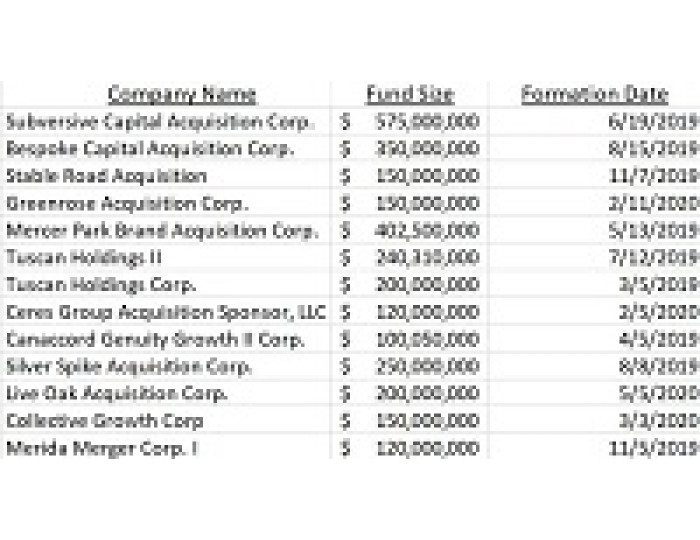
Information provided by the employees of the investment bank ELLO Capital, which works with companies specializing in the medical use of cannabis, suggests that from June 2019 to the present, more than ten SPAC companies have jointly raised more than $ 3 billion. The above companies were created specifically for this purpose. to acquire cannabis businesses as well as companies related to servicing cannabis assets in the rapidly growing market canna until recently. Typically, SPAC companies have 18 to 24 months to take advantage of the resources provided by investors or return the assets received under management. Despite the long existence of hemp SPAC companies, there is activity on their part in the search for liquid assets in the market, but there are no acquisitions or mergers. This is due, among other things, to the fact that industry indicators continue to fall from the highs reached at the beginning of 2019.
According to Herschel Gerson, CEO of ELLO Capital, who specializes in medical cannabis mergers and acquisitions, raising capital, and other transactions in the field of legal psychoactive cannabisa “In the near future, SPAC companies will begin to face the termination of their existence, therefore, the management of a number of specialized firms listed below is in a desperate situation. "

Many of the currently active SPAC companies were formed in the first half of 2019, when estimates of the health of the hemp market were much higher. Time constraints are already critical for Subversive Capital, which raised $ 575 million in June 2019; Mercer Park Brand raised $ 402 million in May 2019; Tuscan Holdings - $ 200 million in March 2019; Cannaccord Genuity - $ 100 million in April 2019
The creation of American SPAC companies was due to the expectations of the rapid growth of the American market in late 2018 - early 2019, due to the legalization of the possibility of using recreational cannabis in Canada, as well as in a number of US administrative divisions. The aforementioned trends of 2 years ago prompted many companies specializing in modern cannabis farming to place their shares on the securities markets of Canada and the United States, often through various kinds of fraud, thereby increasing their attractiveness specifically for SPAC companies.
At a time when the industry is experiencing serious difficulties, fewer companies are available for SPAC deals, as a result of which their employees have long been unable to find candidates for acquisitions with significant indicators of income and profitability.
Individual SPACs seek to consolidate multiple businesses
In accordance with the powers granted, the management of SPAC companies must devote 80% of their capital to work in one enterprise, so their employees usually look for firms with positive cash flow and EBITDA. However, given the current challenges in the industry, a huge number of private cannabis growers do not meet these criteria. Therefore, some SPAC companies seek to combine several cannabis assets in order for the synergy of their merger to make the combined venture work, solving in parallel a number of problems associated with imperfect structure, inadequate management control, lack of sufficient resources, etc.
It should be noted that only a few transactions were concluded on the market using this method. An example would be the 2018 merger of Cannabis Strategies Acquisition with five US and Canadian companies with expected 2019 revenues of up to C $ 270 million. A number of SPAC companies have recently been trying to follow this path, trying to "pull" the indicators of the consolidated assets of the group of enterprises to an acceptable investment level.
According to a number of American experts, the amount of financial resources collected so far for cannabis transactions conducted by SPAC companies exceeds the amount of money required to acquire / acquire viable candidates on the market.
Commentary of experts of the Association "Ukrainian technical hemp"
Over the past 18 months, the North American legal psychoactive cannabis industry, once viewed as having virtually unlimited growth potential, has collapsed. The reasons for this can be attributed to many factors - from national and state restrictions provided for by the current regulatory framework, inexperience of market operators, lack of an institutional investor base, as well as support for long-term projects implemented by hemp companies. Despite the fact that the industry has partially regained its position in the market in recent months, the decline of 75%, which was observed from the beginning of 2019 to March 2020, is clear.