

Development trends of Canadian cannabis companies specializing in working with medical cannabis
Exports from Canada may be completed by 2020, as Canadian firms create overseas (primarily in Europe) extensive cultivation infrastructure, which ultimately displace international supply from the country.
The pages of the specialized electronic publication of Ukrainian growers (http://tku.org.ua) have repeatedly described situations in which “ Canadians are already positioning themselves as the leader of the legal market for psychoactive cannabis ”. However, this extremely profitable market is not so simple, as our overseas colleagues describe. That is why in March 2018 the “ Therapeutic Hemp Manufacturers Market Review ” was held. Without changing the established tradition, in this material we will try to analyze how the global export cannabisa market has changed, in relation to the activities of the main Canadian hemp companies.
Immediately it should be noted that the export of medical cannabis from Canada in 2018, even compared with the previous year, has increased dramatically. The largest Canadian licensed companies producing legal psychoactive cannabis continued to create sites providing opportunities for expansion into new markets for medical cannabis abroad.
The volume of supplies of dried leaves and inflorescences of hemp tripled to 1,460 kg in 2018, compared with 500 kg in 2017 and only 44 kg in 2016.
Export Canadian dried green mass of medical hemp (2015 - 2018)


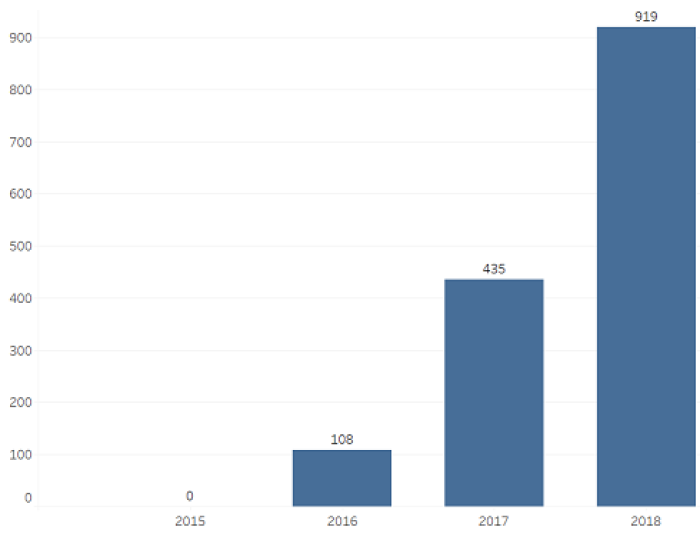
The export of cannabis oil rich in cannabinoids doubled last year to 920 liters compared to 430 liters in 2017 and 100 liters in 2016. In 2015, Cannabis with therapeutic properties was not exported from Canada.
Export сannabinoid-rich Canadian Oil Export


The rapidly growing export of Canadian cannabis companies specializing in medical cannabis is linked to the fact that they are striving to take market positions in countries that have recently provided a legal basis for using legal psychoactive cannabis for medical purposes, as well as in other countries with rapidly developing cannabis markets. .
This trend indicates a growing demand for medical cannabis products in countries that currently do not have the ability to grow their own therapeutic hemp or produce their own products legally for psychoactive hemp raw materials. A vivid example of such a market is Germany.
Securing parts of the rapidly growing demand is the cornerstone of the strategy for many Canadian hemp companies that are publicly traded, whose shares are highly valued in the market due to expectations of rising international sales. All this despite the fact that the volume of the market itself is currently insufficient.
Countries that recently have the opportunity to use cannabis for medical purposes, as a rule, rely on imports to meet the demand of their own citizens. However, while they are trying to independently develop their growing potential and create for this the appropriate regulatory structures, Canadian companies “enter the market” and try to dictate to government officials conditions that are beneficial for expansion into the markets of a particular country.
The total volume of exports of medical cannabis produced in Canada currently ranks third in the overall structure of the global market after the UK (in which GW Pharmaceuticals produces Sativex) and the Netherlands (manufacturer Bedrocan), whose companies are specifically allowed to export 1,500 kg of medical products annually. cannabis only to germany.
Commentary of the Association "Ukrainian technical hemp"
Exports from Canada may be completed by 2020, as Canadian firms create overseas (primarily in Europe) extensive cultivation infrastructure, which ultimately displace international supply from the country. In particular,
- Aurora Cannabis (Alberta, Canada) plans to receive the first “marketable” crop from its company Nordic 1 (Denmark) in mid-2019. The production capacity of this enterprise is “sharpened” on the European, primarily on the German market. The first stage of the construction of Aurora's European business through Nordic 1 included the construction of a capacity of about 1 hectare (100,000 square feet), with further expansion up to 9 hectares (1 million square feet). At the moment the project is under development.
- Rival Canopy Growth (Ontario, Canada) plans to start shipping medical cannabis raw materials from its plant in Odense (Denmark) in September. Its Canopy Spectrum Cannabis subsidiary in Denmark, which occupies a greenhouse of 4 hectares (430,000 square feet), is already licensed to produce therapeutic hemp from the Danish Medicines Agency (Danish Medicines Agency, Laegemiddelstyrelsen).
- Tilray representatives claim that they have already completed harvesting of legal psychoactive cannabis at their base in the EU in Cantanhede (Cantanhede, Portugal) and are expecting to harvest a new crop in the next few months, which is expected to be much larger than the one already harvested. Employees of Tilray Portugal declare that the production facilities in the country are needed in order to facilitate the export to the EU countries of Canadian products manufactured in Europe, and not exported from Canada.
- in the near future on the European market should appear the products of the Cronos Group from Israel. In 2017, the company from Ontario created a joint venture for the production and distribution of medical cannabis precisely in order to work on the EU market with its help. In particular, Cronos Israel is building the first phase of a greenhouse with an area of about 0.4 hectares (45,000 square feet), which, according to the business plan developed as part of the project, should produce up to 5,000 kg of raw materials per year. The start-up period for these capacities is the first half of 2019. In the future, it is planned to create a second phase of the above-mentioned production facility with an area of about 0.16 hectares (17,000 square feet), which “will be launched” in the second half of 2019.