-700x540.JPG)
Not wanting to risk the health of its citizens against possible adverse events associated with the concentration of THC in food, prompted the Government of Switzerland to become the first country in the world to adopt the maximum limits for concentrations of THC in food and fix them in the relevant legal acts.
The three largest German-speaking countries of the DACH abbreviated D (
Germany, Deutschland), A (
Austria, Austria) and CH (
Switzerland, Confoederatio Helvetica).
The Austrian government on the territory of the country allows the sale and consumption of foods containing hemp in its composition components or products, entirely made from parts of industrial hemp plants. There are certain legal requirements to
hemp products sold in the country, taking into account operating in the
Austrian EU standards. The institution responsible for regulating the amount of tetrahydrocannabinol (THC) in the articles and products presented on the Austrian market, is the Austrian Agency for Food Safety and Health (Austrian Agency for Health and Food Safety - AGES).
Based on the EU directive regulating food safety №178 / 2002, the
Austrian government structures allow THC in food at a level of 1-2 mg / kg per day (0.1 million share for person per day, assuming the weight of an adult consumer in an amount of 70 kg ).
Austria does not have its own research into the safe amount of THC in
food, however, it relies on the results of experiments conducted in
Germany. In the following experiments, the subjects consumed hemp chocolate, candy bars, cereals and other
foods made from hemp raw materials. Although there was a significant amount of
hemp eaten food, and body condition evaluation by blood and urine samples were carried out on an hourly basis, there was obtained the results in any way different from those figures, the subjects who had prior to the experiments. Similar experiments were conducted using a significant amount of
hemp tea, showed similar results. The overall conclusion of the study was that
hemp foods that meet the requirements of the German consumed in normal quantities do not lead to the THC concentration in the blood associated with possible adverse effects for the organism.
AGES staff continue to test new
hemp products appear on the food market of
Austria. Previously tested samples of
seeds,
oil,
beer, chocolate, bread and pasta is not subject to inspections. On a regular basis, it verified the presence of THC in selling the country
hemp teas or herbal infusions, using in its composition leaves and inflorescences of cannabis.
The country is a special case of monitoring the presence of THC in
food. This is one of the few countries in the world to have a clear limit the amount of controlled substances for each product, not a guide. The following values of THC in
products and articles of hemp ingredients have been established in order to avoid possible manifestations of psychotropic effects in consumers.
The high concentration of THC was found in the milk of cows fed on leaves and buds of cannabis. Due to the fact that a trace amount of THC was found in Swiss
hemp foods, 1996, countries were introduced government regulations limiting the amount of THC in the
foods made from hemp various components. Not wanting to risk the health of its citizens against possible adverse events associated with the concentration of THC in
food, prompted the Government of
Switzerland to become the first country in the world to adopt the maximum limits for concentrations of THC in food and fix them in the relevant legal acts.
Having analyzed available at the time the research on this subject, the Swiss government has divided the food into subclasses, according to the average daily consumption rates and concentration of THC in them (see table). In order to maintain a degree of flexibility for agricultural producers THC limits in food for all varieties of crops allowed on the market in
Switzerland was set a maximum limit on the tetrahydrocannabinol level of 1%.
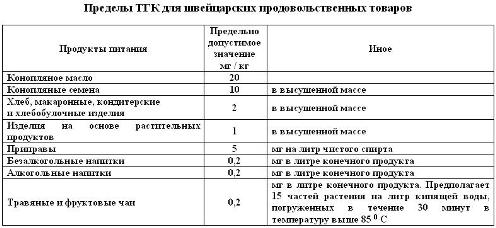
Swiss experts believe that it is impossible to completely exclude the liability in the case of the indicative values of the amount of THC, so the maximum allowable limits are regarded as a necessary alternative to any indicative figures. Until today, there was no single case of THC intoxication due to the use of cannabis constituents during meals from different parts of the cannabis. Such restrictions are important because they help to establish the maximum permissible limits the amount of THC in a huge range of
hemp food products are present in
Switzerland.
The recommendations of the federal government of
Germany in respect of the amount of THC in
food and other products, including hemp ingredients developed by the Federal Institute for Consumer Health Protection and Veterinary Medicine (The Federal Institute for Health Protection of Consumers and Veterinary Medicine, BgVV). The above structure became part of the Federal Institute for Risk Assessment (Federal Institute for Risk Assessment, BFR). It is these government agencies in
Germany were developed and published recommendations on the safe amount of THC permitted in
food and other products used in the country are not limited to residents.
The aim of the work was to create specialists BgVV criteria for assessing the amount of THC and defining permissible thresholds of their presence in
products and products made of hemp raw materials. It is because of specific state structures indicators hemp products are sold on the German market, and is guaranteed to eliminate the adverse effects of excessive consumption of any amount of
cannabis products.
The first step taken by BgVV in the development of the guidelines was the creation of an acceptable daily intake (ADI) of tetrahydrocannabinol. CPD - the amount of a particular substance (a food additive, pesticide residue, etc.) in food and drinking water, which can be ingested daily over a lifetime without a significant risk to human health. Daily limits are usually set for any food component or additive that is harmless in small doses, but can have negative effects in large quantities. They focused on the study of daily intake amounts of THC in order to avoid unwanted side effects
cannabis consumption products. ADI is calculated by establishing the lowest observed level (LOEL), which is then divided by a factor of uncertainty.
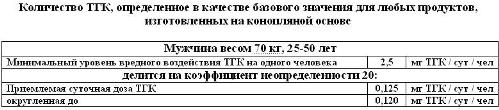
In the scientific literature agree that a single dose of 2.5 mg of THC per person (70 kg body weight) per day can be regarded as a placebo. That is why BgVV used this value as its benchmark the impact on the human body.
After you have created a standard that defines the value of the uncertainty factor. Uncertainty is one of the ways to protect certain categories of people who are more vulnerable to each specific substance. In the case of TGK, this factor has been defined value - 20. Dividing the standard uncertainty on the value obtained in the 0,125 mg per person per day. As an additional security measure, the value is rounded up to 0.12 mg per person per day. The data below summarize the calculations of this kind:
Calculating the value in 0.12 mg of the German experts have deduced reference values for specific food groups. To this end, BgVV used food samples, partially or completely made of hemp raw materials. Set out below is a table that demonstrates the average data consumption of selected products containing in its composition hemp. For simplicity, several food groups were collected in three food categories (first column). Baseline data were obtained based on the average consumption of the above goods per capita granted to the federal government for the 1994, 1995 and 1996. (Column 4) and converted into a daily intake (column 5). The aggregate amount of each category is calculated in column 6. In order to create an additional level of security, the values obtained in the sixth column are rounded (data presented in column 7). This is done in order to assert guaranteed that any excessive consumption even above food will not lead to toxicity.
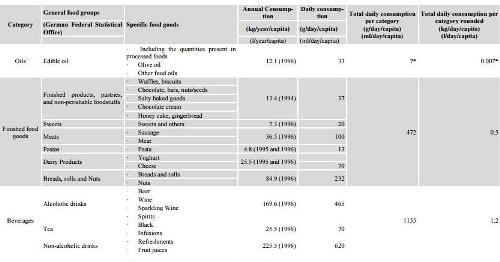
Ready to eat solid food products amounted to 0.5 kg / day / person, and alcoholic and non-alcoholic drinks 1.2 liters / day / person. Despite the fact that the total number of oil consumption per day is 33 g / day / person.,
Hemp oil is limited to 7 g / day / person. Because it loses its advantageous properties when heated. Thus, it is important in 7 g denotes using as a criterion the
hemp oil which can be used to replace other types of oils, without losing their properties.
After determining the value of the acceptable daily dose of THC with a rounded value of the daily consumption of certain food groups, BgVV initiated a definition of standard values taken for each product separately.
A certain value for each category, multiplied by the average daily intake of the person giving the daily value of THC per person for each product category. The sum of all categories of daily users tetrahydrocannabinol per person shall not exceed the amount of THC in the amount stipulated by 0.12 mg per person per day.
In the case of
hemp oil was found TGC value of 5 mg per liter exclusively pragmatic view, since no cases of intoxication when used as a food
hemp oil.
Daily absorption of THC in
hemp oil per person is: 5 (indicative value in mg / kg), multiplied by 0,007 kg (the average daily consumption), which is equivalent to 0.035 mg daily used by man THC. Those. 0,035 mg THC is the total daily amount of psychoactive substances, which can be used when using 7 g of
hemp oil.
Applying similar logic to set drinks daily value tetrahydrocannabinol THC 0.005 mg per kg, whereby it is determined that a person drinks can consume no more than 0.006 x 1.2 = 0.005. In other words, during the day, the person can not consume more than 0,006 mg of THC in the absorption of various kinds of drinks hemp.
The final separation criterion is the difference between the amount received daily dietary TGK per person through the use of hemp oil and hemp beverage (0,041 mg), the universal average daily dose for all other food commodities is 0,158 mg per person per day. This value shall be rounded down, as a precaution to 0.15 mg / kg. The table shows the summed values of the previous calculations.
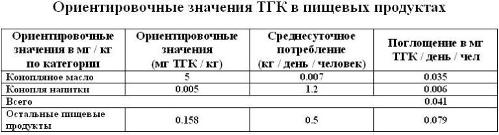
Based on the above, the following table is obtained current values in the THC food

Compliance with these values currently represents the best protection against liability claims. However, the German specialized government agencies have expressed the need for further research, so not all of the effects of THC present in
foods studied enough. For example, not enough knowledge about the psychomotor and endocrine effects with oral THC use. There is insufficient data on the interaction of THC with alcohol or drugs that affect the central nervous system of the person.
To use
hemp oil in cosmetics is also recommended to use only oil that meets the standards for edible oil.
Since the majority of
European countries have not been able to develop their own evaluation criteria THC in
cannabis products, the German standards are often used as benchmarks for other EU member states. Only a few countries, including
Switzerland and
Belgium have their own criteria, such as
hemp oil values in the four and two times higher than the German. Although guidance values should not be confused with binding limit values, the German criteria are widely accepted in practice. They provide a minimum legal framework, making it possible to adhere to the criteria indicated by the producers of
hemp products manufactured by them.
Most products in
Europe correspond to the German tentative criteria. Theoretically, the amount of THC can exceed the values stipulated by German standards only in fatty foods such as chocolate hemp. This is due to the fact that THC is fat-soluble substance.
Please note that by themselves
hemp seeds contain psychoactive substances. TGC on the
seeds can occur only as a result of treatment, when pollen from the plant reaches the grain and have them THC can get into the final product. Nevertheless, the German criteria are considered to be imperfect, as are a number of specific values for maximum THC individual products are too low.
Information taken from the site http://tku.org.ua

