

In Canada, a third of childhood poisonings are associated with THC

The results show that legal psychoactive cannabis or its
derivatives are currently the leading cause of hospital admissions for
poisoning children in Canada. In particular, after the legalization of the use
of foods containing a significant amount of THC in the provinces of Ontario,
Alberta and British Columbia, the number of hospitalizations as a result of
psychoactive poisoning cannabis has more than doubled.
Less than two weeks have passed since, on the pages of the
specialized electronic publication of national cannabis growers, the attention
of our respected readers and listeners was focused on the fact that “Over the
past five years, the number of officially registered tetrahydrocannabinol (THC) poisoning in the United States by young children
has increased 14 times .” It is impossible to ignore the conclusions made by our Canadian
colleagues, who conducted an equally fundamental study showing that a third of
childhood poisoning in Canada occurred in connection with the consumption of
food by small citizens of this country, which included a significant amount of
tetrahydrocannabinol.
The study covered 3.4 million children aged 0 to 9 in several
Canadian provinces. It found that jurisdictions that allow the sale of foods
rich in THC have seen a significant increase in the number of poisonings and
hospitalizations associated with them, compared with those administrative
divisions that banned foods formulated with a significant amount of THC.
After analyzing the data of a 7-year period, Canadian experts
found 581 cases of hospitalization of children associated with psychoactive
cannabis poisoning. The discovery was the data, according to which, among
Canadian provinces where foodstuffs containing THC are legally allowed ,
approximately one third of children's hospitalizations for poisoning were
caused by the use of a psychoactive drug in the formulation. cannabis . In
particular, after the legalization of the use of foods containing a significant
amount of THC in the provinces of Ontario, Alberta and British Columbia, the
number of hospitalizations due to cannabis poisoning more than doubled, and the
share of hospitalizations with psychoactive cannabis poisoning in the total
number of hospitalizations with poisoning increased. by 844.3% over the 7-year
study period from 20 out of 651 (3.1%) in 2015 to 179 out of 617 (29.0%) in
2021.
"These results show that legal psychoactive cannabis or its
derivatives are currently the leading cause of hospitalizations due to
poisoning of children in Canada," the authors of the study say.
Commentary of the specialists of the Association “Ukrainian
Industrial Hemp”
The findings indicate that in Canada, as well as in the United
States, there is an increase in the number of cases of poisoning of young
children with foods that include hemp ingredients with a high content of THC. In
particular, in this regard, in the bipartisan bill signed by the President of
the United States on December 2, 2022 , aimed at expanding and optimizing
research on the therapeutic properties of cannabis, the task is clearly
formulated, according to which, before making any decisions regarding the
regulation of the regulatory base on the mechanisms of use of the therapeutic
properties of cannabis, scientists should provide legislators with objective
data on :
- potential therapeutic effects of cannabidiol or marijuana in serious
diseases, including incurable epilepsy;
- the potential effects of marijuana,
including the effects of elevated levels of delta-9-tetrahydrocannabinol on the
human body and adolescent brain development, and the effects of varying levels
of delta-9-tetrahydrocannabinol on cognitive abilities, such as those required
for driving cars or other heavy equipment .
It must be recognized that in any country that regulates the sale
of foods with a high content of THC, there is a rapid increase in the number of
hospitalizations due to unintentional poisoning of children and the elderly associated with the presence of a
high content of a psychoactive substance in the formulation. At a minimum, this
fact suggests that the amount of tetrahydrocannabinol in the final products
should be limited. The consequence of the appearance of this kind of data
should be an understanding of the importance of making decisions on making
changes to the current regulatory framework of our country not on the basis of
populist statements, but on the basis of a consensus reached during a
professional discussion of specialists who appeal to data obtained as a result
of fundamental research. including on the safety of THC use by
consumers/patients.
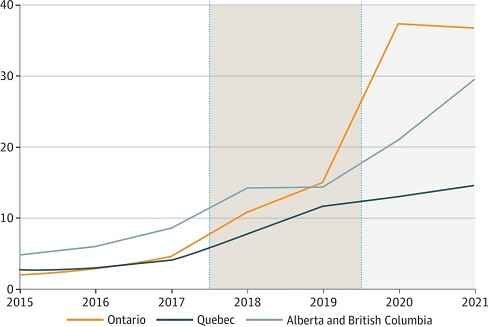
Percentage of hospitalizations of children under 9
due to psychoactive cannabis poisoning in Ontario, Quebec and British Columbia