

Why are national cannabis growers interested in Thai Health Minister's interview?
Despite the good results that the cannabis sector of the country was able to achieve, exploiting the therapeutic properties of the plant, the Minister of Public Health focuses on the need to develop other sectors of modern cannabis cultivation in the country, which allow creating products with high added value. He sees one of the main priorities of the state in creating conditions for attracting foreign investors who will invest the latest technologies in the development of the hemp industry in Thailand. In turn, national companies should strive to create not only closed production chains, but also to form a developed structure of service businesses and related services that can bring significant financial resources to the state budget.
In an interview with the media, Thailand's Minister of Public Health, Mr. Anutin Charnvirakul, praised community-based enterprises throughout the country that grow medical cannabis. Subordinate medical institutions throughout the country use this raw material for the purpose of healing and treating patients, and the therapeutic properties of the plant are used by hundreds of private clinics that have proven its effectiveness. The minister emphasized that his mission is not only to use cannabis as a medicine that helps the whole nation to be healthy, but also to transform the plant into an export-oriented agricultural crop.
According to Mr. Charnvirakul, the growing demand for cannabis products is related to the medicinal properties of the plant, as well as its dietary and physical-mechanical properties, which are driving the exponential growth of the cannabis industry around the world, in almost all sectors of modern cannabis growing. The rapid development dynamics of various sectors of the hemp business is observed primarily in the field of pharmacology; manufacturing food products with essential therapeutic properties - nutraceuticals; various kinds of drinks, as well as cosmetic products.
There is strong domestic demand in the modern cannabis sector, with the hemp plant attracting significant interest from both large Thai conglomerates and small start-ups. Therefore, according to the minister, the task of the Thai government is to form a regulatory framework in which foreign investors will be interested in investing resources in absolutely all areas of development of Thai cannabis growing related to the cultivation, processing and sale of a wide variety of hemp products.
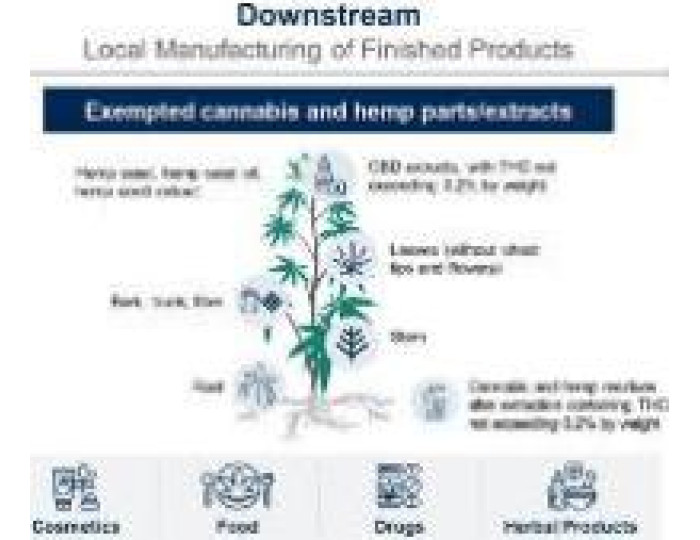
As presented by the minister in the infographic, various parts of the hemp plant are planned for industrial production, with the aim of producing various hemp products with high added value, which have significant growth potential in the market. The country is interested in setting up the manufacture of this kind of finished goods (cosmetics, various kinds of additives, food products and medicines) that can be established by foreign companies in Thailand. In addition, government officials of the country are interested in the development of various related and ancillary businesses that, serving modern sectors of modern cannabis farming, organized by international hemp companies, will be able to bring significant resources in the form of various taxes and fees to the country's budget.
Commentary of the specialists of the Association "Ukrainian technical hemp"
According to experts, by 2025 the volume of the Thai hemp market will be about 15.77 billion baht (more than $ 480 million).
I would like to draw particular attention to the fact that a high-ranking government official in Thailand looks at the development of modern cannabis farming in the country in a complex and extremely progressive manner. Despite the good results achieved by the country's cannabis sector, exploiting the therapeutic properties of the plant, the Minister of Public Health focuses on the need to develop other sectors of modern cannabis cultivation in the country, which allow creating products with high added value. He sees one of the main priorities of the state in creating conditions for attracting foreign investors who will invest the latest technologies in the development of the hemp industry in Thailand. In turn, national companies should strive to create not only closed production chains, but also to form a developed structure of service businesses and related services that can bring significant financial resources to the state budget.
To our deepest regret, the bill initiated by the Ministry of Health of Ukraine, which is currently under public consideration, is not only extremely controversial, but also extremely lobbying. A number of novelties proposed in it lobby the interests of foreign pharmaceutical companies, as well as manufacturers of therapeutically active raw materials from abroad, which, in parallel, are “cleaning the market for themselves” creating conditions under which national producers are destroyed.