

Poland Konoplevodstvo
-700x540.jpg)
In the short term, the country's industry will revive quickly, first of all hemp products filling the domestic market. The main drivers of hemp industry in Poland, as well, and in all other industrialized countries, will hemp food, cosmetics, pharmaceuticals and likely bioenergy. In 2017 the Ministry of Agriculture and Rural Development of Poland has allocated almost five thousand hectares under cultivation of industrial hemp cultivation technology, in light of the projected increase in demand in Europe.
Through analysis of the potential konoplevodstva various European Union countries, it is necessary to pay close attention to the development of the industry with our closest neighbors. In this article an attempt will be made to make a brief analysis of the situation in Poland konoplevodcheskoy industry, as well as display the current trends in the most highly profitable crop market in this country.
The historical aspect
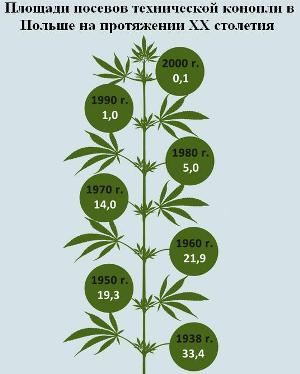
As in other countries of the European continent, hemp for centuries it has been a traditional crop in Poland. In the early twentieth century industrialization of all economic spheres has meant that there were facilities for primary processing plants and konoplevodstvo to 60s to rapidly increase the cultivation and processing. In particular, as seen in the picture presented by our Polish colleagues, before the Second World War, the area of industrial hemp crop in Poland amounted to 33.4 thousand hectares. Naturally the Polish-German, Polish-Soviet War in 1939, the occupation of the country by German and Soviet troops, and then the second wave of active hostilities, swept in 1944, largely destroyed the industrial and agricultural potential of the country, including hemp capacity growing and processing. It is in this connection the area of cannabis cultivation in 1950 amounted to 19.3 thousand hectares. At the peak of flowering Polish konoplevodstva in 1960, the area of crops reached 21.9 ha.
The main factors that contributed to a significant reduction in area planted in 60-ies of the last century were:
- Adoption of the Single Convention on Narcotic Drugs, equates industrial crops industrial hemp and marijuana to the lack of political will of the government to defend the interests of the Polish konoplevodstva the international community was required to destroy the most highly profitable branch of agriculture in the country (as opposed to the government of the USSR);
- Competition from companies in the synthetic deducing market and cheap jute fiber imported from China;
- Reduction in consumption, and further collapse of the hemp industry of the Soviet Union, as a major consumer of raw hemp grown in Poland.
Already in 1970 the crop area was 14 000 hectares, and in 1980 - 5000 hectares. Degradation of the industry at the end of the XX century has led to the fact that in 1990 the area of technical industrial hemp cultivation in the country decreased to thousands of hectares, and at the beginning of the XXI century "collapsed" to 100 hectares.
Modern konoplevodstvo

The development of the Polish konoplevodstva in the XXI century resembles an undulating curves identical to those at the initial stage of their development charted Canadian konoplevodstvo. Such dynamics of the market indicates a significant dependence of the Polish konoplevodstva from external markets, no major capacities for deep processing of raw hemp and focus of the country's agricultural producers to get "fast money" for a short period of annual cultivation. Inserting a serious investment in the creation of capacities for deep processing of cannabis in the last decade it was initiated in the majority in the various European giants and has not yet led to the formation of closed chains with high value-added production.
The Polish part of the raw materials affects the industrial konoplevodstva market in its individual segments, mostly in the domestic market is extremely fragmented and in foreign markets. It should be noted that in spite of the wave-like dynamics of industrial hemp cultivation technical, they have never ceased throughout the XXI century, which certainly indicates the existence of a stable demand, respectively, on the functioning of small processing capacity of raw hemp.
Given the general state of the industry, the history of the Polish konoplevodstva operating processing facilities and human resources can be argued that in the short term the industry in the country will rapidly recover, primarily filling hemp products domestic market. The main drivers of hemp industry in Poland, as well, and in all other industrialized countries, will hemp food, cosmetics, pharmaceuticals and likely bioenergy.
In 2017 the Ministry of Agriculture and Rural Development of Poland has allocated almost five thousand hectares under cultivation of industrial hemp cultivation technology, in light of the projected increase in demand in Europe.
Information taken from the site http://tku.org.ua