

A brief analysis of the market hemp EU
Comparing the production of fiber and the kostra in 2010 and 2013., There are no significant differences in performance. At the same time the volume of grown seeds increased by 92% and the production of "green mass" (flowers and leaves) to 3000%.
Colleagues from the European association of industrial hemp (European Industrial Hemp Association - EIHA) have provided us with information about the situation on the European market konoplevodcheskom. Materials are organized by the following sections:
- Introduction;
- Basic data on the cultivation and processing;
- Information about working with hemp fiber;
- Market data on kostra;
- Use of cannabidiol in the EU countries.
Introduction
Hemp is a multipurpose crop, providing market fiber, kostra, seeds and raw materials for pharmaceuticals ( "green mass"). Currently, hemp fiber is mostly grown in the EU for the production of paper, textile and knitted products, insulation and biocomposite materials. Kostra zoobusiness used (as pet bedding), as well as in construction. Hemp seeds or their derivatives are used in the food, cosmetic and pharmaceutical fields partially. Nepsihoaktivnye cannabinoids, such as cannabidiol, is widely used as a raw material for the pharmaceutical industry, as well as for the production of biologically active additives and special products.
Hemp as one of the main agricultural products grown in Europe for many hundreds of years. In fact, until the end of the sailing fleet it was cannabis was one of the most important crops in key European countries - the UK, France, Holland, Germany, Spain and Italy. One of the main applications of hemp raw materials is the use of fiber for the production of canvas, canvas, burlap, cloth, ropes and cables.
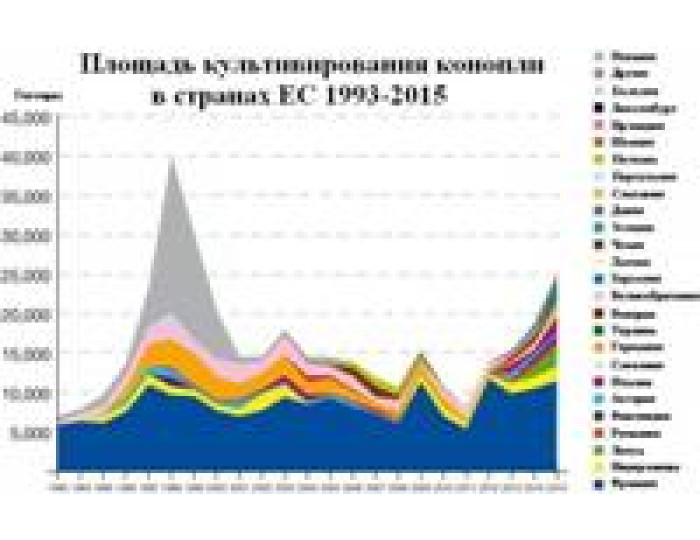
In 2015, the industrial area of industrial hemp crops in the EU amounted to 25 224 hectares. The rapid growth in Europe konoplevodstva associated with the unique properties of plants, cost-effectiveness and efficiency of its cultivation, matching the basic criteria of the functioning of a modern "green" economy.
Basic data on the cultivation and processing
.JPG)
The information provided describes the data in 2013 which is a fundamental principle of the total cultivation area of 15,700 hectares component. The picture presents the development of hemp sown areas in the European Union from 1993 to 1996, a period during which most of the key EU states had legalized the cultivation of industrial hemp cultivation technology. In 2011, the sown area dropped to its lowest level since 1994 (about 8,000 hectares), but increased during 2012-2014., Surpassing the 2015 mark of 25 thousand. Ha. According hemp EU market experts in Europe is expected to further increase in the area of technical hemp crops. The locomotives of the European Union konoplevodcheskoy industry at the moment are France and Holland. In the past few years, almost all the EU countries started cultivating hemp or continued expansion of the area of industrial crops of plants, mainly in order to produce seeds or leaves and inflorescences.
In 2013, with 15,700 hectares of the crop was harvested trusts at a rate of 85,000 tons. This volume of raw material was processed at enterprises in the following amounts:
• produced 25,000 tons of fiber
• produced 43,000 tonnes of kostra
• 13,000 tons hemp dust (60% granulated for subsequent combustion of 40% was used as compost or for other uses such as additives in the manufacture of pavement).
It should be noted that kostra produced 1.7 times more than the hemp fiber. Some hemp companies in Europe specialized in the production of hemp seed either exclusively or in growing "green mass" (leaves and inflorescence).
In particular, it was made in 2013:
• 11,500 tons of seeds (in 2010 - 6000 tons) - for food and beverages
• 240 tons of leaves and inflorescences (in 2010 - 7.5 tons) - are used in the medical and pharmaceutical purposes, for the production of food additives, dietary supplements, essential oils, as well as cosmetics and pharmaceuticals.
Attention is drawn to the fact that by comparing the production of fiber and the kostra in 2010 and 2013., There are no significant differences in performance. At the same time the volume of grown seeds increased by 92% and the production of "green mass" (flowers and leaves) to 3000%. This recycling of leaves and inflorescence for production cannabidiol has enabled agricultural enterprises to obtain significant profits in 2013.
It should also be noted that hemp is one of the few crops that are grown on non-organic farms without the use of any chemicals. Strong, fast-growing seedlings of cannabis can suppress weeds without the necessary support of the chemical, with the yield does not suffer from any pests or diseases. It can be noted that hemp makes sense to be regarded as one of the key crops needed for organic farming.
Information taken from the site http://tku.org.ua