

Brief analysis of hemp M&A market
If a European country is seen as a promising one, the major players in the hemp market are first and foremost exploring the possibility of acquiring a local hemp company rather than creating their own subsidiary.
The past two years have seen a rapid increase in the number of mergers and acquisitions taking place in both the U.S. and Canadian markets, as well as in global cannabis markets. M&A deals in the hemp sector have accelerated sharply, and the dynamics of their implementation are clearly increasing quarter by quarter and year by year.
Canada Cannabis Mergers & Acquisitions Market
Canadian cannabis companies specializing in the cultivation and processing of therapeutic cannabis are increasingly looking for opportunities to expand their operations and intensify development and growth processes both in Canada and globally.
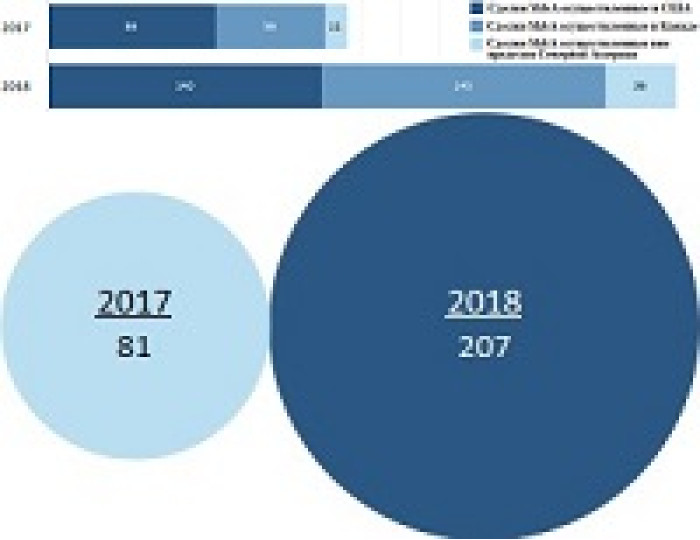
Canada's cannabis companies in 2018 alone in their home countries attracted a record $9 billion to work in this business. (C$ 11.96 billion). Among other things, there are clear consolidation trends in the hemp market of the country. In particular, last year Canadian cannabis companies were involved in 207 mergers and acquisitions, more than doubling their share in 2017.
At the same time, some analysts in the North American hemp market argue that this kind of consolidation of companies is primarily aimed at the survival of the rapidly structuring Canadian sappa business in competition. That is, the leaders of the Canadian hemp market first of all enter the international market, acquiring assets in Europe, Asia, Australia or South America. Consolidation, which is observed in Canada itself, refers to small market players who understand that they need additional resources and scaling up in order to continue operating in Canada's highly competitive cannabis market. A key market trend is that in the global arena, the buyers involved in M&A transactions are primarily Canadian hemp companies.
Number of Canadian companies involved in mergers and acquisitions in 2017-2018


M&A in the US
In the past year, 140 U.S. companies associated with the modern cannabis industry have become mergers and acquisitions, far more than in 2017.
Activity on the Canadian Securities Exchange (CSE) to acquire/acquire Canadian companies aimed at carrying out various operations in the U.S. has increased.
Separate stock exchange rules prohibit cannabis companies listed on the Toronto Stock Exchange and TSX Venture Exchange from retaining any interest in the U.S. cannabis business, other than those transactions involving industrial cultivation of technical cannabis. These restrictions encourage Canadian hemp companies to seek opportunities to unite and enter other global medical cannabis markets. In their turn, the companies that list their shares on the Canadian Stock Exchange do not face such restrictions.
Outside the North American hemp market there has been a significant increase in mergers and acquisitions, especially in the last three quarters of 2018.
Localization of mergers and acquisitions in the global cannabis market


M&A transactions outside North America
In&n some respects, we can say that the hemp market of mergers and acquisitions is gradually gaining momentum in Europe. The number of M transactions outside of the North American continent tripled last year and reached 36 transactions. In 2018, there were more transactions with cannabis companies outside of Canada than in Canada. In particular, a number of Canadian cannabis companies are working to create springboards for further European expansion by acquiring shovels, primarily in Germany. Companies are seeking to exploit the growing potential demand for cannabis products on the continent and the solid financial resources of European Union citizens.
In the past year, there has been a tendency that if a European country is seen as a promising one, the major players in the hemp market are first and foremost exploring the possibility of acquiring a local hemp company rather than creating their own subsidiary. It is quicker and easier to buy someone who has a license for this type of activity than to create a structure whose employees will have to go through a long and painful process of obtaining permits.
In view of the rapidly developing hemp markets in Southeast Asia and the interest in staking out certain sectors of the dynamically developing hemp industry in the region, it is likely that some of the M M A transactions in the near future will take place in Asian countries, and that the vast majority of M transactions will take place in the Asia-Pacific region.