

Issues to be raised in response to huge amounts of cannabis being destroyed in Canada
What are the guarantees that this kind of “Canadian illiquid” will not enter the national market. Where are the algorithms or procedures prescribed in the regulatory framework of our country, which provide at least control by the relevant structures over those raw materials that can be legally imported into the territory of Ukraine. Accordingly, as Ukrainian producers of raw materials similar in their therapeutic characteristics, obtained from technical hemp for therapeutic purposes (in which the amount of THC is below 0.08%) will be able to compete at least on the domestic market if this kind of illiquid product is sold below the cost of its production.
Since the legalization of adult recreational use in late 2018, Canadian growers have destroyed millions of packaged hemp products and hundreds of tons of unpackaged marijuana every year. Industry experts suggest that the huge destruction volumes reflect many factors preventing hemp products from entering the Canadian market, from quality, lack of outlets, and stockpiling ahead of the 2020 launch of products such as food products or concentrates made from legal psychoactive hemp. ...
The difficulties in marketing grown produce only underscore the challenges licensed growers in Canada have faced over the past three years and shed light on the vast amount of psychoactive cannabis that has remained unsold in Canada since the launch of legal marijuana sales in the country in October 2018.
Licensed growers destroyed an estimated 447,118 kg (or nearly 500 tonnes) of unpackaged dried legally grown psychoactive cannabis between 2018 and 2020, according to data released by Health Canada, the federal agency tasked with regulating the production of legal psychoactive cannabis in the country.
However, the actual tonnage of marijuana destroyed is believed by market experts to be much higher because the raw hemp figure does not include packaged legal psychoactive cannabis, defined by Health Canada as “stocked marijuana ready for sale”.
In addition to the nearly 450,000 kilograms of unpackaged legal psychoactive cannabis destroyed, nearly 6 million packs already prepared for sale were destroyed in 2019 and 2020.
The destroyed "packets" of legal marijuana or various plant derivatives consisted of:
• 3,783,397 packages of dried hemp;
• 1,500,396 packs of extracts;
• 714,491 packaging of edible hemp products;
• 943 packages matching the category other.
Health Canada did not disclose why growers eradicated cannabis, but industry sources cite various reasons for regular eradication, including:
• sales channels are clogged with non-selling goods;
• the marijuana was produced prior to obtaining the appropriate licenses - ie. actually “came” from the drug market;
• low-quality products;
• products for testing only;
• growers stockpiled legal psychoactive cannabis in 2019, for example to launch edibles and extracts in 2020.

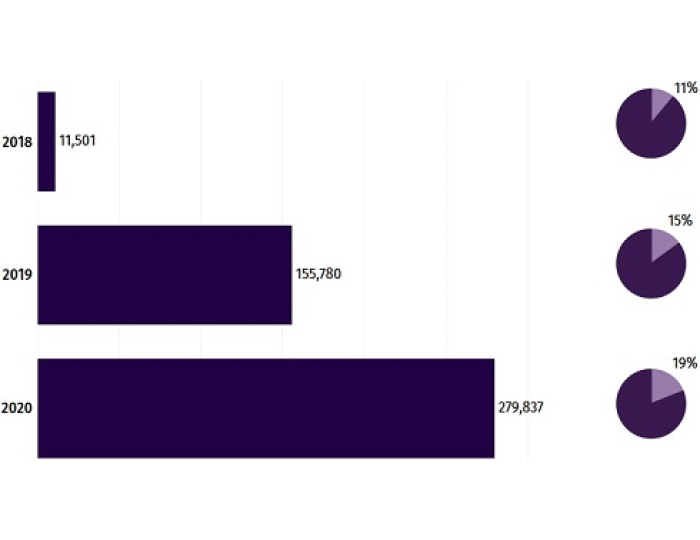
According to industry experts of the market, since the end of 2018, the total number of destroyed legally produced psychoactive plants has been steadily growing. In 2018, unpackaged legal dried psychoactive cannabis was reportedly destroyed at 11,501 kg, or 11% of production. A year later, this amount increased to 155,780 kg or 15% of production. In 2020, licensed Canadian growers destroyed 279,837 kg of unpackaged marijuana, or nearly 20% of the 1,473,767 kg of dried cannabis produced last year.
Huge unclaimed reserves
As of the end of 2020, approximately 1,141,092 kilograms of dried marijuana were in stocks from federal license holders, provincial wholesalers and retailers. Ninety-five percent of the above volume was held by holders of federal licenses.
An inventory of legally grown psychoactive cannabis combined with destroyed marijuana shows that as of the end of 2020, at least 1,591,092 kg of psychoactive plant have not been sold.
The above confirms once again the fact that Canadian producers of legal psychoactive cannabis were clearly making too rosy business plans for the market, relying on constantly increasing sales volumes, which led to huge stocks of unsold products, as well as the construction of excess production capacity.
Aphid and mold infestation
According to Canadian cannabis market participants, destruction levels indicate an excess of low-quality products or raw materials, as well as a lack of variety of varieties entering the market. Certain large legal psychoactive cannabis growers in Canada lose about 30% of their crop annually. However, so that such problems do not affect the financial statements of such enterprises, they will store illiquid goods / raw materials and destroy small quantities of “illiquid” on a quarterly basis so as not to draw additional attention to this process. According to participants in the Canadian hemp market, “There are manufacturers who have had a product in their store for four years. They are waiting for an opportunity to destroy it, but they do it so that no one knows about these actions, and they do not affect the final financial result of the enterprise. " In addition, the lack of sufficient cultivation experience from agricultural producers leads to the fact that many products are infected with aphids and mold. It's pretty standard in the industry, but most agricultural producers won't tell you. "
Commentary of the specialists of the Association "Ukrainian technical hemp"
In commercial horticulture, annual losses of 5% to 8% can be expected due to insect infestations, plant diseases, crop failure and bad weather. If companies destroy 15% or more of their stocks, this should be a cause for serious concern. Huge waste and repeated crop failures in commercial gardening are the exception, not the norm, and not the way to run a profitable business.
The current federal regulation in Canada does not prescribe a specific method for the destruction of substandard / contaminated hemp products or raw materials. Since there are no rules for destroying legally grown marijuana, companies can use one of several methods;
- filling the litter box for kittens, when legally grown psychoactive hemp is mixed with cat litter before disposal (not an effective method of destruction and is acceptable for companies that have small amounts of raw materials destroyed);
- incineration or composting.
The above methods do not imply strict control on the part of law enforcement agencies over how and how much low-quality products or legally grown psychoactive hemp raw materials are destroyed. An extremely simple but logical question arises - if such a large amount of illiquid hemp products or raw materials is annually destroyed in the country, and there is virtually no control mechanism for the destruction of these products, who guarantees that its owners will not economically spend money on the destruction of products, or raw materials, in which a significant amount of resources have been invested, and to sell "illiquid" at a dumping price in any other than the Canadian markets. And now the next logical question - what are the guarantees that this kind of “Canadian illiquid” will not enter the national market. Where are the algorithms or procedures prescribed in the regulatory framework of our country, which provide at least control by the relevant structures over those raw materials that can be legally imported into the territory of Ukraine. Accordingly, as Ukrainian producers of raw materials similar in their therapeutic characteristics, obtained from technical hemp for therapeutic purposes (in which the amount of THC is below 0.08%) will be able to compete at least on the domestic market if this kind of illiquid product is sold below the cost of its production.