

What's interesting about hemp straws
The use of hemp in such widespread products once again demonstrates not only the mass nature of technologies for replacing fossil raw materials with similar natural ones. The USA has prepared a production base necessary for the widespread provision of hemp semi-finished products to enterprises, which are then used to manufacture final products with high added value.
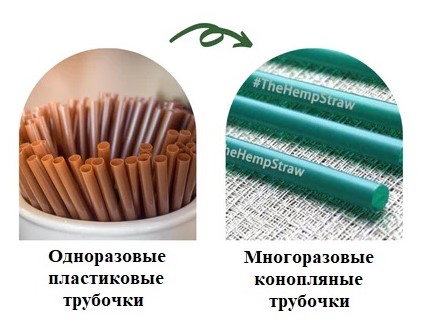
In the market of economically developed countries of the world, there is an increasingly common trend to replace fossil raw materials or traditional products made from them with similar ones, the basis of which are the various properties of the hemp plant. Another manifestation of this kind of global trend is the creation of the American company “ Hemp Paper Straw Company Inc. ” reusable hemp straws that are effectively composted at the end of their useful life and subsequently decompose without harming the environment.

According to a company spokesperson, “Our straws are made from a proprietary blend of organic hemp and recycled paper fibre. The organic hemp used in production is regenerated every three months, making the raw material used in the production process the most sustainable plant on our planet. Bioplastic straws (made from 80% hemp raw material) are completely biodegradable : once in the environment, they break down naturally without releasing harmful microplastics . In addition, hemp requires less water and pesticides to grow than other industrial crops, and the plant is able to absorb large amounts of CO₂ during its growth cycle. This means that the use of hemp-based bioplastics can help reduce greenhouse gas emissions and combat climate change.”

Commentary from experts of the Association “Ukrainian
Industrial Hemp”
According to a study published in the journal Science Advances ”,
91% of plastic produced ends up in landfills or in the environment. The vast
majority of plastic is still single-use. When waste such as straws enter
ecosystems, they decompose into tiny microplastic fragments that eventually
pollute the seas and land. Microplastics fragment in the environment and have a
devastating effect on fauna, and when they enter the food chain, they pose a
significant health risk to humans and animals.
Another study conducted by the University of Newcastle in
Australia showed that every week a person consumes an average of five grams of
microplastic , mainly through water, but also through products such as fish and
shellfish. Although all the negative effects of microplastics on the human body
have not been studied, a significant number of scientists claim that it
negatively affects the endocrine system and contributes to the initiation of
various types of inflammatory processes in the body of mammals.
The use of hemp in such widespread products once again demonstrates not only the mass nature of technologies for replacing fossil raw materials with similar natural ones. The USA has prepared a production base necessary for the widespread provision of hemp semi-finished products to enterprises, which are then used to manufacture final products with high added value.

< Previous article Next article >