

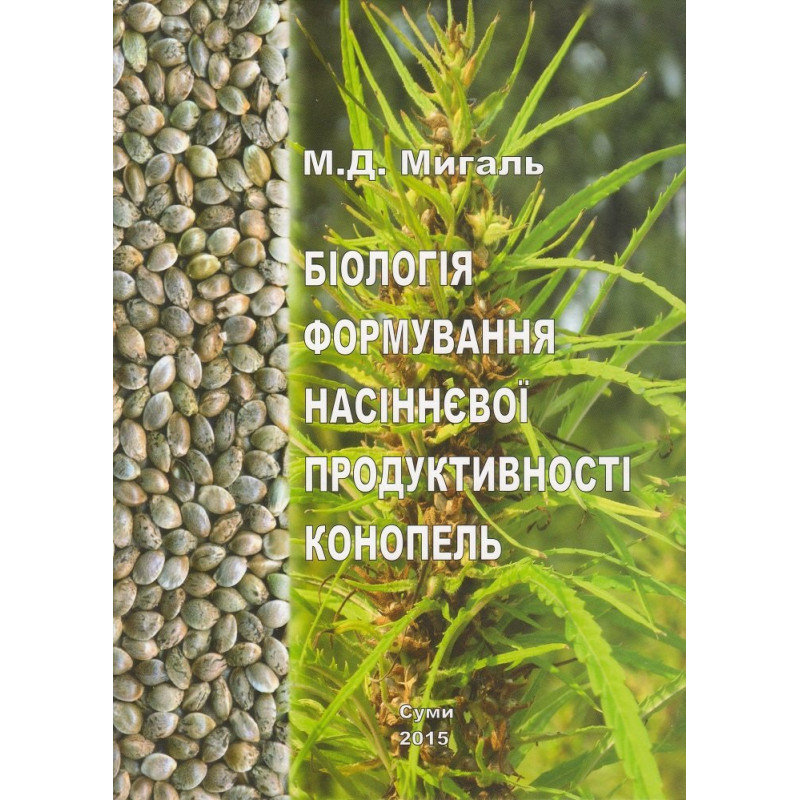
Biology formation hemp seed productivity
250.00 грн.
- Product Code: Биология формирования семенной продуктивности конопли.
- Availability: In Stock
Select a categories
250.00 грн.
The book summarizes the results of studies on the biology of the formation of seed hemp production. The features of formation and functioning of male and female generative organs and dust-fertilization as the wind-pollinated plants of cannabis culture with its inherent polymorphism sexual types. It is shown that the mass of seeds per plant depends on many internal and external factors - such as gender, the collection of the sample, varieties, hybrids, inbreeding progenies, a mutant form, crop density, weather conditions, and others.
A separate section is devoted to a new direction of research related to the influence of elements of plant structure on seed production. The main elements of the plant structure, providing a substantial increase in seed weight is to increase the length and width of the inflorescence.
The data on the extent of seed productivity trait variability and its correlation with other biological and economically valuable traits. We analyzed the relationship patterns of the mass of seeds per plant and fiber content in the stem as the main indicators of selected varieties that provide the level of hemp production yields.
CONTENT
Foreword 4
SECTION 1. generative organs and their functioning 8
1.1 Men's generative organs 8
1.2 Women's generative organs 17
1.3 The shape and size of seeds 19
1.4 Coating of seeds 26
1.5 oilseeds 33
1.6 sprout seeds 41
Conclusion 44
SECTION 2 seed production ENVIRONMENTAL AND types of floors 49
2.1 Features of the research seed production 49
2.2 Environmental samples and grade 52
2.3 Phenotypic differences genotipovye and sexual forms and types 57
2.4 Seed production of sexual forms and types 62
2.5 Ontogenetic intersexuality monoecious plants in relation to seed production 69
2.6 The causes of genital shedding of 71
Conclusion 73
SECTION 3: ELEMENTS OF PLANTS AND THEIR ROLE IN SEED PRODUCTIVITY 75
3.1 Signs of plant structure 75
3.2 Form of inflorescences on the outer outline 77
3.3 Differences sorts the elements of plant structures and seed production 81
3.4 Effect of crop density to replace elements of plant structures and seed production 84
3.5 The relationship of elements of plant structure in a highly rarefied sowing 88
3.6 Effect of density of plants to changes in the structure of stalks and its cutting height at harvest 99
3.7 Impact on the issue stems elements of plant structures and seed production 106
Conclusion 120
SECTION 4 seed production of hybrids and INTSUHT- OFFSPRING 125
4.1 Features of self-pollination and hybridization 125
4.2 Artificial isolation and pollination 127
4.3 Hybridization dioecious hemp 130
4.4 Hybridization hemp nettle sodnodomnoy 133
4.5 Hybridisation of monoecious hemp 142
4.6 Self-pollination of plants (inbreeding) 143
4.7 Changing the signs of the elements of plant structures and seed production of hybrids of the first generation 148
Conclusion 158
SECTION 5. Mutagenesis AS A METHOD OF THE NEW MATERIAL SELECTION 162
5.1 Experimental mutagenesis 162
5.1.1 Colchicine 162
5.1.2 Chemical mutagens 168
5.1.3 Gamma rays 175
5.2 Spontaneous mutagenesis 177
5.2.1 monoecious plants 177
5.2.2 Zholtosteblevye plants 178
5.2.3 Muzhskosterilnye plants 179
5.2.4 Plants with node 184 is a triple stem
Conclusion 185
SECTION 6.IZMENCHIVOST AND RELATIONSHIP SIGNS seed production 188
6.1 Variability of seed production of feature 188
6.2 Correlation feature of seed production 194
6.3 Relationship attributes fiber content and seed production in the offspring selection 199
6.3.1 Selection of plants for fiber content 200
6.3.2 Selection of plants for seed production 205
Conclusion 208
REFERENCES 211