

Brief analysis of the hemp market in Germany

Industrial hemp in Germany will continue
to be a niche crop in the medium term. Despite all the obstacles, given the
potential of the hemp plant amid growing environmental concerns and the EU's
attempts to address climate change, the prospects for the plant in the
country's market are certainly positive.
The area under industrial hemp cultivation in Germany has
been increasing for the sixth year in a row. Despite the significant number of
obstacles that the modern hemp industry of the country constantly faces, in
2022 the area of industrial cultivation of industrial hemp increased by 7% compared
to 2021, reaching a record level of 7000 hectares. Perhaps more important than
the total number of fields, the number of farms growing the highest-grossing
crop has more than doubled in the last five years, with low-narcotic hemp
cultivation areas growing from less than 300 hectares in 2017 to 889 ha in 2022
(+67%).
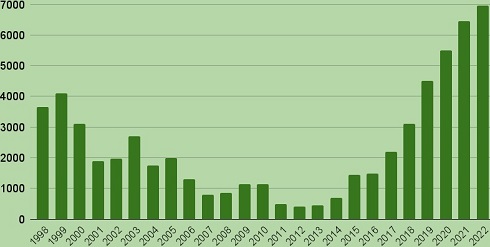
Dynamics of German acreage of industrial hemp
Insufficient price level
Despite the fact that on the one hand there is a steady
increase in the market for hemp seeds and an increase in the number of farmers
who grow hemp raw materials to obtain the fibrous part of the plant, the
fundamental problems of the industry remain unchanged. The price level is still
insufficiently satisfying the requirements of agricultural producers, which may
indicate that, with changes in market conditions, German farmers will refuse to
grow the plant in favor of other higher- margin crops. This problem is
exacerbated by the country's volatile economy, which has already reduced
consumer spending power due to inflation, as well as changing weather patterns
that are leading to longer and hotter summers.
The dominance of bureaucratic
procedures
The dominance of outdated bureaucratic procedures continues
to hold back the German hemp industry. The interpretation of the current
regulatory framework of the country in their own way by the prosecutor's office
and the police regularly leads to disregard for EU directives regarding
industrial hemp and completely unreasonable prosecution by law enforcement
agencies of enterprises specializing in the cultivation, processing or sale of
end products from hemp raw materials.
Use of all components of the hemp
plant
For the first time after many years of "oblivion"
technical hemp appeared in Germany in the 90s of the last century. During the
first two decades of the 21st century, German growers focused mainly on the
cultivation of industrial crops to obtain hemp seeds used as various kinds of
food. This staked out the German hemp companies' market position, giving them
the opportunity to develop an excellent credit history and consumer base. The
ability to use cheap EU credit resources made it possible to survive the boom
and bust of the CBD market, which has been observed in the EU since 2019, quite
painlessly . Established supply chains and hemp products that do not contain
therapeutically active hemp ingredients that have already found their customers
have provided an opportunity for most companies in the hemp industry in Germany
to calmly survive the coronavirus pandemic , inflation associated with the war
in Ukraine, as well as the spasmodic dynamics of the CBD market. However, in
the medium term, agricultural producers specializing in the cultivation of hemp
raw materials will not be able to compete with similar products, for example,
from China or Canada, if they do not establish mutually beneficial cooperation
with industrial capacities not only for processing a single part of the plant
(grain or fiber), but and they will not take care of the two or three -sided
use of hemp raw materials (leaves and inflorescences for obtaining
therapeutically active elements, the fibrous part of the plant for obtaining
semi-finished products for use in construction, the production of textile /
knitwear or biocomposite materials).
Conclusion : industrial hemp in Germany will continue
to be a niche crop in the medium term. Despite all the obstacles, given the
potential of the hemp plant amid growing environmental concerns and the EU's
attempts to address climate change, the prospects for the plant in the
country's market are certainly positive.
Commentary of the specialists of the
Association “Ukrainian Industrial Hemp”
The problems and prospects for the development of modern
cannabis in Europe, individual countries of the Asia-Pacific region, as well as
North and South America will be explained in detail during the eighth course of
training for students of the “ Hemp
University ”.